

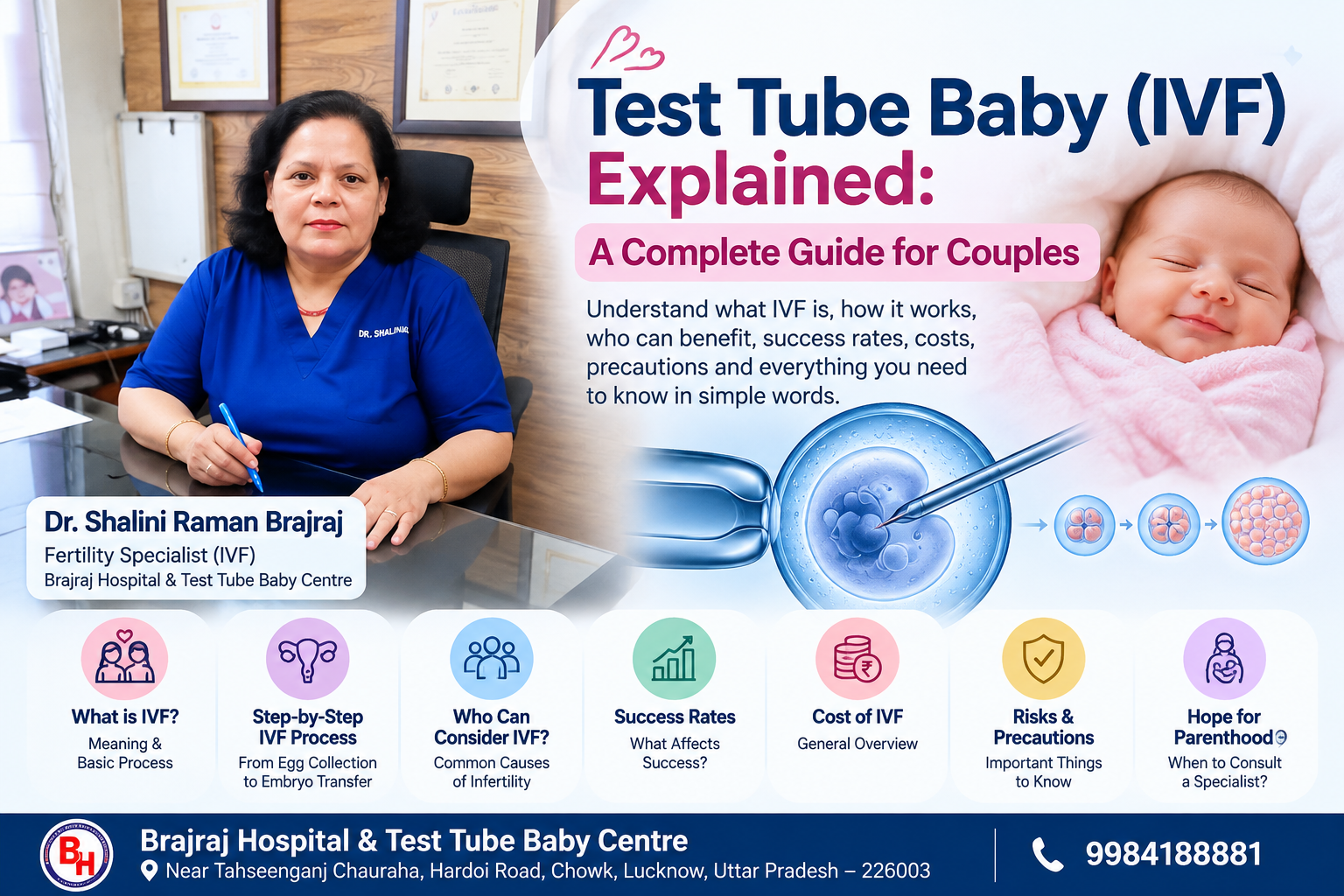
Test Tube Baby (IVF) Explained: A Complete Guide for Couples
Introduction
For couples who are experiencing difficulty conceiving, fertility treatment can provide additional options for building a family. One of the most widely known assisted reproductive technologies is In Vitro Fertilization (IVF), commonly referred to as the test tube baby treatment.
The term “test tube baby” can sometimes create confusion. IVF does not mean that a baby develops inside a test tube. Instead, fertilisation takes place in a specialised laboratory, where an egg and sperm are brought together under controlled conditions. If an embryo develops successfully, it can then be transferred into the woman’s uterus, where pregnancy may continue naturally.
IVF has become an established fertility treatment, but it is not suitable or necessary for every couple. The appropriate treatment depends on factors such as age, fertility history, ovarian function, sperm quality, fallopian-tube condition and the underlying cause of infertility.
Couples searching for a test tube baby center in Lucknow should therefore focus not only on treatment availability but also on specialist expertise, laboratory facilities, counselling and personalised treatment planning.
What Is a Test Tube Baby?
“Test tube baby” is a commonly used term for a baby conceived through In Vitro Fertilization (IVF).
During IVF, eggs are collected from the ovaries and sperm is obtained from the male partner. The eggs and sperm are handled in a specialised embryology laboratory. After fertilisation, the resulting embryo is monitored for development.
An embryo that is considered suitable for transfer may then be placed into the uterus.
The pregnancy itself develops inside the uterus—not in a laboratory.
How Does IVF Treatment Work?
Although every treatment plan is individualised, a typical IVF cycle involves several stages.
1. Initial Fertility Evaluation
The first step is understanding why pregnancy has not occurred.
Both partners may undergo evaluation. Depending on the circumstances, this can include medical history, physical examination, blood tests, ultrasound, semen analysis and other fertility investigations.
The fertility specialist uses these findings to determine whether IVF is appropriate or whether another treatment may be more suitable.
2. Ovarian Stimulation
In a natural menstrual cycle, usually one egg becomes mature and is released.
During IVF, fertility medicines may be prescribed to stimulate the ovaries so that multiple follicles can develop.
The response is monitored using ultrasound examinations and, when required, blood tests.
The medication dosage may be adjusted according to the individual’s response.
3. Egg Retrieval
Once the follicles have developed appropriately, the doctor administers medication to prepare for egg retrieval.
The eggs are collected through a procedure known as oocyte retrieval or egg retrieval.
The collected eggs are then transferred to the embryology laboratory for assessment.
4. Sperm Collection
A sperm sample is generally collected from the male partner around the time of egg retrieval.
The laboratory evaluates the sample and prepares the sperm for fertilisation.
If significant male-factor infertility is present, additional techniques such as ICSI (Intracytoplasmic Sperm Injection) may sometimes be considered.
5. Fertilisation
In conventional IVF, prepared sperm are placed with mature eggs in the laboratory to allow fertilisation to occur.
In selected cases, ICSI may be used, where a single sperm is directly injected into a mature egg.
The choice between conventional IVF and ICSI depends on the couple’s clinical circumstances.
6. Embryo Development
After fertilisation, the resulting embryos are monitored in the embryology laboratory.
The laboratory team observes their development over the following days.
Depending on the treatment plan and embryo development, the fertility team may decide when an embryo is appropriate for transfer.
7. Embryo Transfer
An embryo selected for transfer is placed into the uterus using a thin catheter.
Embryo transfer is generally a relatively short procedure.
The number of embryos transferred is carefully considered because transferring multiple embryos can increase the risk of multiple pregnancy.
8. Pregnancy Test
Following embryo transfer, the fertility team provides instructions about medication and follow-up.
A pregnancy test is performed after the appropriate interval.
If pregnancy occurs, further monitoring is arranged to assess early pregnancy development.
Who May Need IVF?
IVF can be considered for different causes of infertility.
Possible indications include:
- Blocked or damaged fallopian tubes
- Certain cases of male-factor infertility
- Ovulation disorders when other treatments have not worked
- Endometriosis-associated infertility
- Reduced ovarian reserve in selected situations
- Unexplained infertility
- Previous unsuccessful fertility treatments
- Certain genetic or fertility-preservation circumstances
Not every couple with infertility requires IVF.
In some cases, simpler treatments such as ovulation induction or IUI may be considered before IVF.
The appropriate approach depends on the couple’s individual evaluation.
IVF and Male Infertility
Infertility is not only a female health issue.
Male factors contribute to a significant proportion of infertility cases. Problems may involve sperm count, movement, morphology or sperm production.
A semen analysis is commonly part of the fertility evaluation.
When sperm-related problems are significant, techniques such as ICSI may be considered alongside IVF.
In some situations, specialised sperm-retrieval procedures may also be required.
A complete fertility evaluation should therefore involve both partners.
IVF and Age
Age is an important factor in fertility treatment because egg quantity and quality generally change over time.
Female fertility tends to decline with increasing age, particularly because of changes in egg quality.
This can affect the likelihood of natural conception as well as IVF outcomes.
However, age is only one factor. Sperm quality, ovarian reserve, embryo development, uterine health and the underlying cause of infertility can also influence treatment outcomes.
A fertility specialist can provide a more individualised assessment after evaluating the couple.
Does IVF Guarantee Pregnancy?
No. IVF does not guarantee pregnancy or a live birth.
IVF can provide an opportunity for fertilisation and embryo transfer, but several stages must occur successfully before a healthy pregnancy develops.
Outcomes can be influenced by:
- Age
- Egg quality
- Sperm quality
- Embryo quality
- Uterine health
- Underlying medical conditions
- Previous fertility history
- Number of embryos available
Couples should therefore be cautious about clinics or advertisements that present a single success rate as a guarantee.
Is IVF Safe?
IVF is an established medical procedure, but like any medical treatment, it has potential risks.
For example, ovarian stimulation medicines can sometimes cause ovarian hyperstimulation syndrome (OHSS). IVF pregnancies may also require additional monitoring because some risks can be higher depending on the patient’s age, health and reproductive circumstances. The American Society for Reproductive Medicine describes IVF as a well-studied and generally safe procedure while also recognising potential risks.
The fertility specialist should explain the expected benefits and possible risks before treatment begins.
Choosing a Test Tube Baby Center in Lucknow
Couples looking for a test tube baby center in Lucknow should consider more than advertisements or online claims.
Important factors include:
Fertility Specialists
Check the qualifications and experience of the fertility specialists.
Embryology Laboratory
The laboratory plays an important role in IVF because fertilisation and embryo development are handled outside the body.
Diagnostic Facilities
A centre with appropriate fertility investigations can make the evaluation and treatment process more organised.
Transparency
Ask for a clear explanation of treatment stages, medicines, laboratory charges and additional procedures.
Counselling
Fertility treatment can be emotionally and financially demanding. Good communication and counselling can help couples understand their options.
Follow-Up Care
Ask how the centre manages monitoring after embryo transfer and during early pregnancy.
IVF Cost in Lucknow
The cost of IVF varies between fertility centres and depends on the individual treatment plan.
Expenses may include:
- Initial consultation
- Fertility investigations
- Medicines
- Ultrasound monitoring
- Egg retrieval
- Laboratory charges
- Embryo culture
- Embryo transfer
- Cryopreservation, if required
- Additional procedures such as ICSI or genetic testing
Couples should ask for an itemised estimate rather than relying on a single advertised package price.
Questions to Ask Before Starting IVF
Before beginning treatment, couples can ask their fertility specialist:
- What is the likely cause of infertility?
- Is IVF the best treatment for our situation?
- Could IUI or another treatment be considered first?
- How many IVF cycles might be required?
- What investigations are needed?
- Will ICSI be recommended?
- What are the expected costs?
- Are additional laboratory procedures required?
- What are the potential risks?
- How will our treatment progress be monitored?
Clear answers can help couples make informed decisions.
Conclusion
A test tube baby is a commonly used term for a baby conceived through In Vitro Fertilization (IVF). In IVF, eggs and sperm are handled in a specialised laboratory, fertilisation takes place outside the body, and a developing embryo may subsequently be transferred into the uterus.
IVF can be considered for several causes of infertility, including blocked fallopian tubes, certain male-factor problems, ovulation disorders, endometriosis, unexplained infertility and previous unsuccessful fertility treatments.
However, IVF is not a guaranteed solution and is not necessarily the first treatment for every couple. A detailed fertility evaluation of both partners is important before deciding on treatment.
For couples searching for a test tube baby center in Lucknow, comparing specialist expertise, embryology laboratory facilities, treatment transparency, counselling and follow-up care can help them make a more informed choice.
Most importantly, fertility treatment should be personalised. A qualified fertility specialist can help couples understand their diagnosis, available options, expected outcomes, potential risks and the likely treatment pathway.
Frequently Asked Questions
What is a test tube baby?
A test tube baby refers to a baby conceived through IVF. Fertilisation occurs in a specialised laboratory before the resulting embryo is transferred to the uterus.
Is a test tube baby different from a naturally conceived baby?
The method of conception is different, but IVF babies develop in the uterus after embryo transfer. IVF itself does not mean that the baby develops in a test tube.
How long does an IVF cycle take?
The duration varies between patients and treatment protocols. Some stages may take several weeks, and additional time may be required depending on the treatment plan.
Is IVF painful?
Some parts of IVF, such as injections and egg retrieval, may cause discomfort. The experience varies between individuals. The fertility team should explain what to expect before each procedure.
Is IVF successful for everyone?
No. IVF success varies according to factors such as age, egg and sperm quality, embryo quality, uterine health and the underlying cause of infertility.
Can male infertility be treated with IVF?
Yes. IVF may be used for selected cases of male-factor infertility. ICSI may also be considered when sperm-related problems make conventional fertilisation difficult.
How much does IVF cost in Lucknow?
There is no single fixed price. The total cost depends on medicines, investigations, laboratory procedures and any additional treatments required.
How should I choose an IVF centre in Lucknow?
Compare fertility specialists, laboratory facilities, treatment transparency, counselling, follow-up care and the clinic’s approach to personalised treatment rather than choosing solely on advertised success rates.
Brajraj Hospital & Test Tube Baby Centre
Address: Near Tahseenganj Chauraha, Hardoi Road, Chowk, Lucknow, Uttar Pradesh – 226003
Phone: 9984188881
Medical Disclaimer: This article is intended for general educational purposes only and does not constitute medical advice, diagnosis or treatment. Fertility treatment should be planned with a qualified fertility specialist after an appropriate evaluation of both partners.