

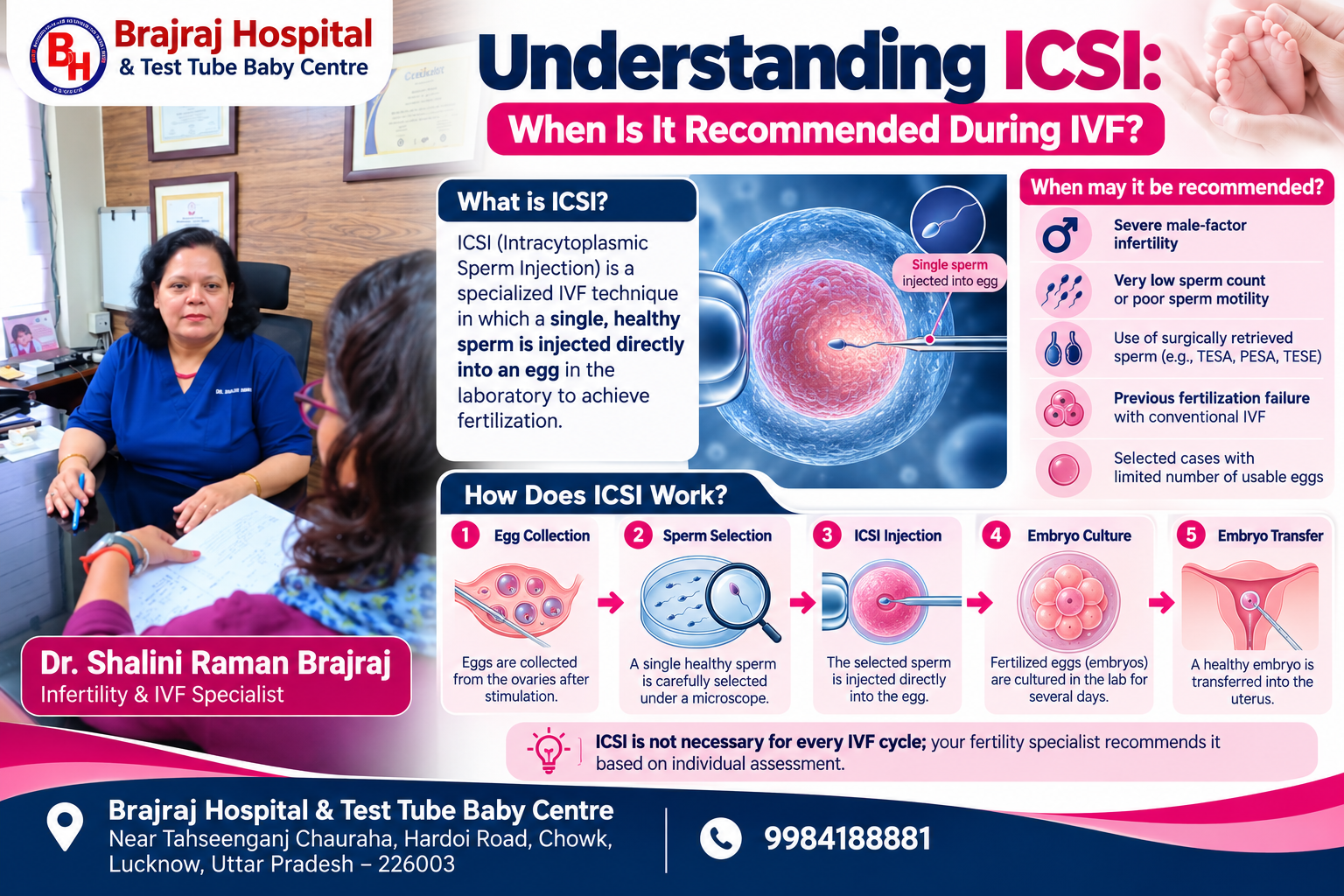
Understanding ICSI: When Is It Recommended During IVF?
SEO Title: ICSI Treatment in Lucknow: Process, Benefits & Risks
Meta Description: Learn what ICSI treatment is, when it is recommended during IVF, how the procedure works, its benefits, risks, and factors affecting treatment outcomes.
Focus Keyword: ICSI treatment Lucknow
Secondary Keywords: intracytoplasmic sperm injection, ICSI procedure, IVF with ICSI, male infertility treatment, low sperm count treatment, fertility specialist in Lucknow
Introduction
For couples experiencing difficulty conceiving, assisted reproductive technologies such as in vitro fertilisation (IVF) can provide additional treatment options. One specialised technique used in some IVF cycles is Intracytoplasmic Sperm Injection (ICSI).
ICSI is a laboratory procedure in which a single sperm is injected directly into an egg to help achieve fertilisation. It is commonly considered in certain cases of male-factor infertility, previous fertilisation failure, or when sperm has been surgically retrieved.
Although ICSI can be beneficial in appropriate situations, it is not necessary for every IVF cycle. Understanding the procedure, its advantages, limitations, and associated costs can help couples make informed decisions with their fertility specialist.
If you are exploring ICSI treatment in Lucknow, this guide explains the essential information in simple terms.
What Is ICSI Treatment?
ICSI stands for Intracytoplasmic Sperm Injection. It is an advanced fertilisation technique performed in an embryology laboratory as part of an IVF treatment cycle.
In conventional IVF, prepared sperm and eggs are placed together in a laboratory dish, allowing fertilisation to occur naturally under controlled conditions.
During ICSI, an embryologist selects a single sperm and injects it directly into a mature egg using specialised equipment.
This technique bypasses some of the steps involved in sperm reaching and penetrating the egg. However, it cannot guarantee fertilisation, embryo development, implantation, or pregnancy.
ICSI is different from IVF as a whole: IVF is the broader treatment process, while ICSI is one method that may be used to fertilise eggs during IVF.
When Is ICSI Recommended?
The decision to use ICSI depends on the patient’s medical history, sperm parameters, previous treatment results, and the fertility specialist’s assessment.
1. Very Low Sperm Count
When sperm concentration is significantly low, conventional IVF may have a reduced chance of fertilisation in some cases.
ICSI allows the embryologist to select an individual sperm for injection into each suitable mature egg. It may therefore be recommended for selected patients with severe male-factor infertility.
2. Poor Sperm Motility
Sperm motility describes how effectively sperm move. Reduced motility can make it more difficult for sperm to reach and fertilise an egg.
ICSI bypasses the need for sperm to travel to and penetrate the egg independently. The sperm must still be suitable for injection, and fertilisation is not guaranteed.
3. Previous Fertilisation Failure
If a previous IVF cycle resulted in very low or no fertilisation, the specialist may consider ICSI in a subsequent cycle.
The decision should take into account the previous cycle’s findings and whether the problem was related to sperm, egg characteristics, laboratory factors, or another cause.
4. Surgically Retrieved Sperm
In some men, sperm is not present in the ejaculated semen because of a blockage or a sperm-production problem. In selected cases, sperm may be obtained directly from the epididymis or testicle through a medical procedure.
ICSI is often used when suitable sperm is obtained through surgical retrieval because the available sample may be limited or may not be suitable for conventional IVF.
5. Selected Cases Involving Frozen Eggs
When previously frozen eggs are thawed for treatment, ICSI may be considered because the freezing and thawing process can affect the egg’s outer layer.
The fertility team will recommend a fertilisation method based on the circumstances of the cycle and the clinic’s protocols.
Is ICSI Necessary for Every IVF Patient?
No. ICSI is not automatically required for everyone undergoing IVF.
For couples without a clear indication, conventional IVF may be an appropriate option. The specialist should explain why ICSI is being recommended and whether it offers a meaningful benefit in the particular case.
Step-by-Step ICSI Procedure
ICSI is usually performed as part of an IVF cycle. The process involves several stages.
Step 1: Fertility Evaluation
The doctor reviews both partners’ medical history and recommends appropriate investigations. These may include semen analysis, hormone testing, ultrasound, and other tests according to the patient’s needs.
Step 2: Ovarian Stimulation
The female partner may receive medication to stimulate the ovaries to develop multiple follicles. Ultrasound scans and sometimes blood tests help monitor the response.
Step 3: Egg Retrieval
When the follicles are considered ready, eggs are collected through a procedure performed under appropriate medical supervision.
Step 4: Sperm Preparation
The laboratory prepares the sperm sample and identifies sperm that may be suitable for injection. If sperm has been surgically retrieved, the embryology team assesses the available sample.
Step 5: Sperm Injection
An embryologist uses specialised equipment to inject one sperm into each selected mature egg. This requires precision and laboratory expertise.
Step 6: Fertilisation Assessment
The eggs are checked afterward to determine whether normal fertilisation has occurred. Not every injected egg will fertilise successfully.
Step 7: Embryo Development
Fertilised eggs are cultured in the laboratory while embryologists monitor their development. Depending on the treatment plan, a suitable embryo may be transferred or frozen for later use.
Step 8: Pregnancy Testing
A pregnancy test is scheduled after embryo transfer at the time advised by the fertility clinic. A positive result is followed by appropriate medical monitoring.
Benefits of ICSI Treatment
ICSI can offer several advantages when there is a clear medical indication.
- Addresses selected sperm-related problems: It can help bypass some barriers to fertilisation associated with severe male-factor infertility.
- Uses an individual sperm: A single suitable sperm is selected for injection into each mature egg.
- May help after previous fertilisation failure: It can be considered when conventional IVF has resulted in very low or no fertilisation.
- Can be used with surgically retrieved sperm: It provides a fertilisation option in selected cases where sperm is obtained directly from the reproductive tract.
However, successful fertilisation is only one stage of treatment. ICSI does not eliminate other causes of infertility or guarantee a successful pregnancy.
ICSI vs Conventional IVF
| Feature | Conventional IVF | ICSI |
|---|---|---|
| Fertilisation method | Eggs and prepared sperm are placed together | One sperm is injected into a mature egg |
| Common use | Suitable cases without a specific ICSI indication | Selected male-factor or fertilisation-related cases |
| Sperm penetration | Sperm must penetrate the egg independently | Injection bypasses this step |
| Laboratory technique | Standard IVF fertilisation | Requires specialised micromanipulation |
| Pregnancy guarantee | No | No |
Neither method is universally superior. The appropriate choice depends on the clinical indication and the expected benefit for the individual patient.
Risks and Limitations of ICSI
ICSI is an established technique, but it has limitations that should be discussed before treatment.
1. Fertilisation may not occur. Even after sperm injection, some eggs do not fertilise normally.
2. Not every fertilised egg becomes an embryo suitable for transfer. Embryos may stop developing during laboratory culture.
3. Egg damage is possible. The injection process can damage some eggs, although it is performed by trained embryology professionals.
4. Pregnancy is not guaranteed. Implantation and pregnancy depend on several factors, including egg and sperm characteristics, embryo development, age, and uterine health.
5. Genetic factors may require assessment. Some causes of severe male infertility are associated with genetic conditions. Depending on the diagnosis, a specialist may recommend genetic counselling or testing.
ICSI itself does not correct every underlying fertility problem. The treatment plan should address the couple’s overall reproductive health.
What Factors Affect ICSI Success?
Outcomes vary considerably between patients. Important factors include:
- Age of the female partner.
- Number and maturity of retrieved eggs.
- Sperm quality and the underlying cause of infertility.
- Embryo development and laboratory conditions.
- Uterine health and other reproductive factors.
- Previous fertility treatment history.
For this reason, general success rates should not be interpreted as a prediction for an individual couple. Ask the fertility specialist to explain which outcome is being discussed, such as fertilisation, clinical pregnancy, or live birth.
What Is the Cost of ICSI Treatment in Lucknow?
The cost of ICSI treatment varies between clinics and according to the treatment plan. It may depend on medication requirements, laboratory procedures, investigations, egg retrieval, embryo freezing, and whether additional procedures are needed.
Some clinics include ICSI within an IVF package, while others charge it separately. There is no single price that applies to every patient.
Before starting treatment, request a written estimate that explains what is included, which services are billed separately, and what additional costs could arise if another cycle or frozen embryo transfer is needed.
Frequently Asked Questions
1. Is ICSI better than IVF?
ICSI is a technique used during IVF. It can be beneficial for selected indications, especially certain male-factor infertility cases, but it is not necessarily better for every patient.
2. Does ICSI guarantee fertilisation?
No. It improves the ability to introduce a selected sperm into a mature egg, but fertilisation may still fail.
3. Is ICSI painful?
The injection is performed on the egg in the laboratory, not inside the patient’s body. However, the overall IVF cycle includes medical procedures such as egg retrieval, which may involve sedation or anaesthesia.
4. Can ICSI be used when sperm count is extremely low?
It may be an option in selected cases. The specialist must assess sperm availability, quality, and the underlying cause of the low count.
5. Is ICSI suitable for everyone undergoing IVF?
No. The choice between conventional IVF and ICSI should be based on individual clinical findings and a discussion with the fertility specialist.
Conclusion
ICSI is an important assisted reproductive technique that may help couples facing certain male-factor infertility problems or previous fertilisation difficulties. By injecting a single sperm directly into a mature egg, it bypasses some of the steps required for conventional fertilisation.
However, ICSI is not necessary for every IVF cycle and does not guarantee pregnancy. A personalised fertility assessment can help determine whether conventional IVF, ICSI, or another treatment approach is most appropriate.
If you are considering ICSI treatment in Lucknow, consult a qualified fertility specialist to discuss your test results, treatment options, expected costs, and potential risks.
Medical disclaimer: This article is for educational purposes only and does not replace personalised medical advice, diagnosis, or treatment.
Hospital Details
Brajraj Hospital & Test Tube Baby Centre
Address: Near Tahseenganj Chauraha, Hardoi Road, Chowk, Lucknow, Uttar Pradesh – 226003
Phone: 9984188881
Website: https://brajrajhospital.com/
Contact the hospital to confirm current consultation availability and the specific ICSI services offered.