

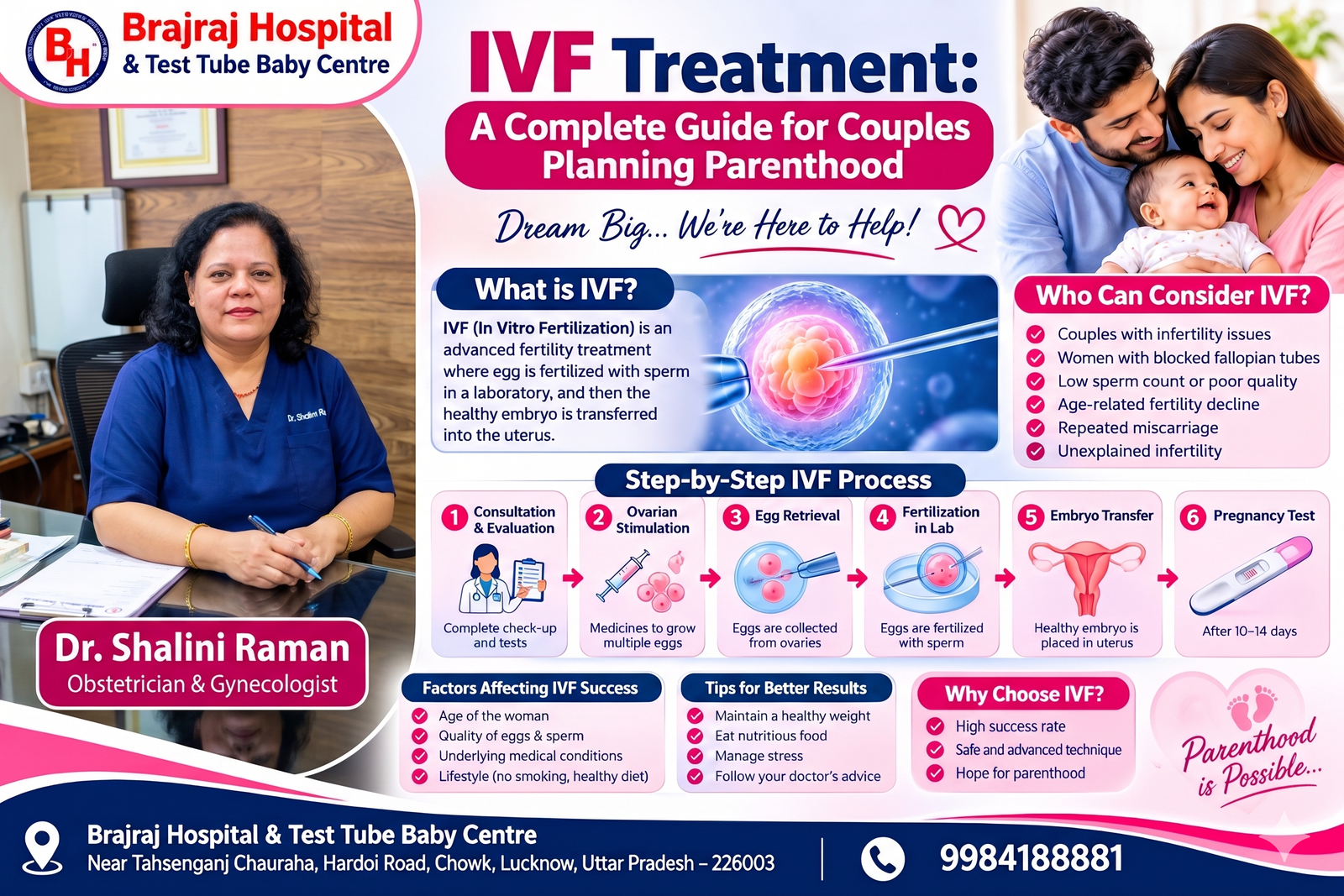
IVF Treatment: A Complete Guide for Couples Planning Parenthood
SEO Title: IVF Treatment in Lucknow: A Complete Guide for Couples
Meta Description: Learn about IVF treatment, who may need it, the step-by-step process, benefits, risks, and important factors to consider before starting IVF treatment.
Focus Keyword: IVF treatment Lucknow
Secondary Keywords: IVF process, infertility treatment Lucknow, fertility treatment, embryo transfer, IVF specialist Lucknow
Introduction
For many couples, starting a family happens naturally. However, some couples experience difficulty conceiving despite trying for a long time. In such situations, a fertility evaluation can help identify possible causes and guide the next steps.
In Vitro Fertilisation (IVF) is one of the most widely used assisted reproductive treatments. It involves collecting eggs from the ovaries, fertilising them with sperm in a specialised laboratory, and transferring a suitable embryo into the uterus.
IVF has helped many individuals and couples with different fertility challenges. However, it is important to understand that IVF is not a guaranteed solution. Treatment outcomes depend on several factors, including age, the cause of infertility, egg and sperm health, embryo development, and overall reproductive health.
For couples considering IVF treatment in Lucknow, understanding the treatment process can make the journey feel more manageable and help them ask the right questions before beginning treatment.
What Is IVF?
IVF stands for In Vitro Fertilisation. The term refers to fertilisation that takes place outside the body in a carefully controlled laboratory environment.
During a typical IVF cycle:
- The ovaries are stimulated to develop multiple follicles.
- Mature eggs are collected from the ovaries.
- Eggs are fertilised with sperm in the laboratory.
- The resulting embryos are monitored as they develop.
- A suitable embryo may be transferred into the uterus.
- Additional suitable embryos may be frozen for future treatment, depending on the treatment plan.
The exact process may vary from one patient to another. A fertility specialist creates an individual treatment plan based on medical history and fertility assessment.
Who May Benefit From IVF Treatment?
IVF may be considered for several fertility-related conditions.
Blocked or Damaged Fallopian Tubes
The fallopian tubes play an important role in natural conception. If both tubes are severely damaged or blocked, it may be difficult for the sperm and egg to meet naturally.
IVF can bypass the fallopian tubes because fertilisation takes place in the laboratory.
Male-Factor Infertility
Sperm-related problems, such as a significantly low sperm count or poor sperm movement, can affect natural conception.
Depending on the severity of the problem, conventional IVF or a specialised technique such as ICSI may be recommended.
Ovulation Problems
Some people experience irregular or absent ovulation. Medication may help in many cases, but IVF may be considered when other treatments have not been successful or when additional fertility factors are present.
Endometriosis
Endometriosis can affect fertility in different ways. Depending on its severity, age, symptoms, and other fertility factors, IVF may be one of the treatment options discussed.
Unexplained Infertility
Sometimes, routine fertility tests do not identify a clear reason why pregnancy has not occurred. This is often described as unexplained infertility.
The appropriate treatment depends on age, the duration of infertility, and previous treatment history. IVF may be considered in selected circumstances.
Step 1: Fertility Assessment
Before beginning IVF, both partners are generally evaluated.
The doctor may discuss:
- Medical and reproductive history.
- Previous pregnancies or miscarriages.
- Menstrual cycle patterns.
- Previous fertility treatment.
- Past surgeries or medical conditions.
- Current medications.
Depending on the situation, tests may include ultrasound examinations, hormone tests, ovarian reserve assessments, and semen analysis.
The purpose of these investigations is to understand the possible causes of infertility and create a suitable treatment plan.
Step 2: Ovarian Stimulation
During a natural menstrual cycle, one egg usually develops and is released during ovulation.
During IVF, fertility medications may be used to stimulate the ovaries so that multiple follicles can develop.
The patient attends regular monitoring appointments, which may include ultrasound scans and blood tests.
The fertility specialist monitors the response carefully and adjusts the treatment plan when necessary.
Every person responds differently to fertility medication. The number of follicles and eggs can vary significantly from one treatment cycle to another.
Step 3: Egg Retrieval
When the follicles have reached an appropriate stage, the doctor schedules the egg retrieval procedure.
Egg retrieval is usually performed with appropriate sedation or anaesthesia. Using ultrasound guidance, the doctor collects fluid from the ovarian follicles. The embryology laboratory then examines the fluid to identify the eggs.
After the procedure, some patients may experience mild discomfort or cramping.
The fertility team provides instructions regarding recovery and explains which symptoms require medical attention.
Step 4: Sperm Collection and Fertilisation
A sperm sample is prepared by the laboratory around the time of egg retrieval.
There are two common fertilisation methods:
Conventional IVF
The eggs and prepared sperm are placed together in a laboratory environment, allowing fertilisation to occur under controlled conditions.
ICSI
Intracytoplasmic Sperm Injection, commonly known as ICSI, involves injecting a single sperm directly into a mature egg.
ICSI may be recommended for selected situations, particularly certain male-factor infertility problems or previous fertilisation difficulties.
The fertility specialist recommends the most suitable method according to the couple’s individual circumstances.
Step 5: Embryo Development
After fertilisation, the embryology team monitors the developing embryos.
Not every egg will fertilise, and not every fertilised egg will continue developing into an embryo suitable for transfer.
Embryos may be cultured in the laboratory for several days. Some may reach the blastocyst stage around Day 5 or Day 6.
Embryologists assess embryo development using established laboratory criteria. However, even a good-looking embryo cannot guarantee implantation or pregnancy.
Step 6: Embryo Transfer
Embryo transfer is an important stage of IVF treatment.
A suitable embryo is placed inside the uterus using a thin catheter. The procedure generally does not involve surgery.
The number of embryos recommended for transfer depends on several factors, including:
- Age.
- Embryo development.
- Medical history.
- Previous treatment outcomes.
- Clinical recommendations.
In many situations, transferring one embryo may help reduce the risks associated with multiple pregnancy.
Some patients may have a fresh embryo transfer, while others may have suitable embryos frozen for transfer during a future cycle.
Fresh vs Frozen Embryo Transfer
A fresh embryo transfer takes place during the same treatment cycle as egg retrieval.
A frozen embryo transfer takes place in a later cycle after an embryo has been frozen and the uterus is appropriately prepared.
The decision depends on the individual’s medical condition and treatment plan.
For example, the fertility specialist may recommend delaying embryo transfer when the body needs additional recovery or when another treatment approach is considered more suitable.
The best option varies between patients.
Factors That Affect IVF Success
One of the most common questions about IVF is, “What is my chance of success?”
There is no single answer because outcomes depend on several important factors.
Age
Age is one of the most significant factors, particularly when using a person’s own eggs. Egg quantity and the likelihood of chromosomal abnormalities can change with age.
Cause of Infertility
IVF outcomes may differ depending on whether the main issue involves the fallopian tubes, sperm, ovulation, endometriosis, or multiple fertility factors.
Egg and Sperm Health
Egg maturity and sperm characteristics can influence fertilisation and embryo development.
Embryo Development
Embryos develop differently. Some may stop developing before reaching the stage suitable for transfer or freezing.
Uterine Health
The condition of the uterus and uterine lining can also be important for embryo implantation.
Because every patient is different, general success percentages should not be considered a prediction of an individual’s outcome.
Benefits of IVF Treatment
IVF can provide several potential benefits for selected patients.
- It can help bypass blocked or damaged fallopian tubes.
- It provides a treatment option for certain male-factor infertility problems.
- It allows fertilisation and embryo development to be monitored in a laboratory.
- Suitable embryos may be frozen for possible future use.
- It may be combined with specialised techniques such as ICSI when medically appropriate.
However, IVF also involves medical procedures, medication, financial considerations, and emotional challenges. Patients should understand both the potential benefits and limitations before starting treatment.
Risks and Considerations
Like any medical treatment, IVF has potential risks and side effects.
Fertility medication can sometimes cause side effects, and some patients may develop ovarian hyperstimulation syndrome (OHSS), particularly when the ovaries respond strongly to medication.
Egg retrieval involves a medical procedure and carries risks such as bleeding, infection, or complications related to sedation, although serious complications are uncommon.
Multiple pregnancy can also carry additional health risks. This is one reason why single-embryo transfer may be recommended in appropriate cases.
The fertility specialist should explain the potential risks and how they apply to an individual’s treatment plan.
How to Prepare for IVF Treatment
Preparation can help patients feel more organised before beginning treatment.
Follow Medical Advice
Take medications exactly as prescribed and attend all monitoring appointments.
Maintain General Health
Avoid smoking and recreational drugs. Discuss alcohol use, diet, exercise, and weight management with your doctor.
Review Medicines and Supplements
Tell your fertility specialist about all prescription medicines, over-the-counter products, and supplements you are using.
Prepare Emotionally
Fertility treatment can involve uncertainty and emotional stress. Support from a partner, family, counsellor, or trusted healthcare professional can be valuable.
Frequently Asked Questions
Is IVF painful?
Some stages, such as injections and egg retrieval, may involve discomfort. Appropriate pain management or sedation is generally used for egg retrieval.
How long does an IVF cycle take?
The timeline varies according to the treatment protocol and individual response. Your fertility clinic can explain the expected schedule for your treatment.
Does IVF guarantee pregnancy?
No. IVF can improve the chances of pregnancy in selected situations, but no fertility treatment can guarantee a successful outcome.
Is ICSI the same as IVF?
No. ICSI is a specialised method of fertilising eggs that may be used as part of an IVF treatment cycle.
Can embryos be frozen?
Suitable embryos may be frozen for future use according to the treatment plan and applicable medical and legal requirements.
Conclusion
IVF is a detailed fertility treatment involving medical assessment, ovarian stimulation, egg retrieval, laboratory fertilisation, embryo development, and embryo transfer.
For many couples, understanding each step can reduce uncertainty and make it easier to prepare for the treatment journey.
If you are considering IVF treatment in Lucknow, a complete fertility evaluation can help determine whether IVF is appropriate for your situation. A qualified fertility specialist can explain the potential benefits, limitations, costs, and treatment options based on your individual medical needs.
The most important step is to make informed decisions with proper medical guidance and realistic expectations.
Medical Disclaimer: This article is for general educational purposes only and does not replace personalised medical advice, diagnosis, or treatment. Always consult a qualified fertility specialist regarding your individual circumstances.
Hospital Details
Brajraj Hospital & Test Tube Baby Centre
Address: Near Tahseenganj Chauraha, Hardoi Road, Chowk, Lucknow, Uttar Pradesh – 226003
Phone: 9984188881