

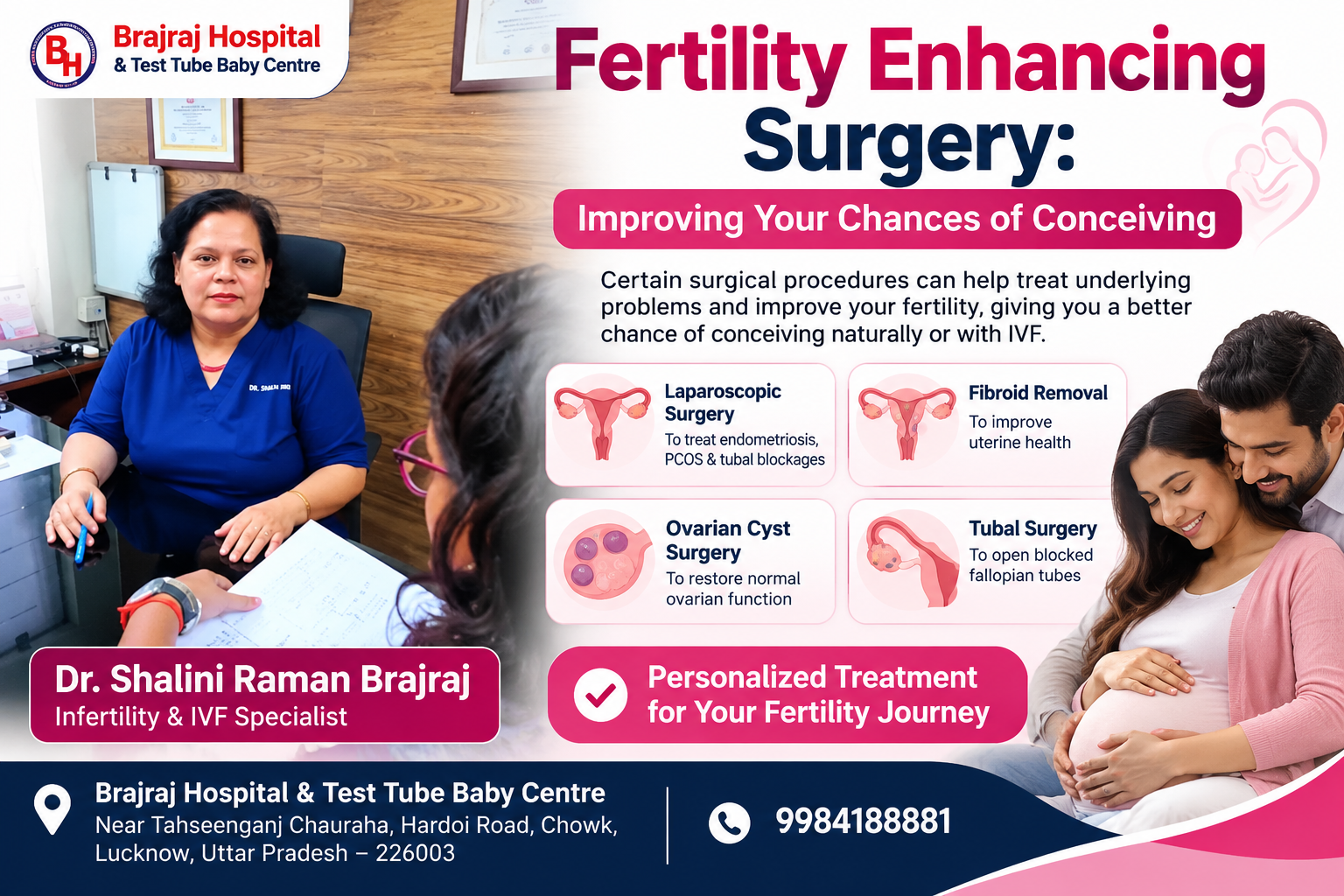
Fertility Enhancing Surgery: Improving Your Chances of Conceiving
SEO Title: Fertility Surgery in Lucknow: Types, Benefits & Risks
Meta Description: Learn how fertility surgery may help treat blocked fallopian tubes, fibroids, endometriosis and other reproductive conditions. Explore procedures, benefits and risks.
Focus Keyword: fertility surgery Lucknow
Secondary Keywords: fertility enhancing surgery, infertility surgery, laparoscopy for infertility, blocked fallopian tube treatment, fibroid removal for fertility, endometriosis surgery, fertility specialist in Lucknow
Introduction
For couples trying to conceive, discovering a fertility problem can be emotionally challenging. While medication, intrauterine insemination (IUI), and in vitro fertilisation (IVF) are common fertility treatments, surgery may also be helpful in selected situations.
Fertility-enhancing surgery refers to procedures that treat specific problems affecting the reproductive organs. These may include blocked fallopian tubes, certain uterine fibroids, endometriosis, pelvic adhesions, or structural abnormalities.
However, surgery is not necessary for everyone experiencing infertility. Its potential benefits depend on the underlying condition, the patient’s age, ovarian reserve, other fertility factors, and whether natural conception or assisted reproductive treatment is the preferred approach.
If you are exploring fertility surgery in Lucknow, understanding the available procedures and their limitations can help you have a more informed discussion with a qualified fertility specialist.
What Is Fertility-Enhancing Surgery?
Fertility-enhancing surgery aims to correct a physical or structural problem that may be interfering with conception or pregnancy.
For example, surgery may help restore the normal anatomy of the fallopian tubes, remove a fibroid that distorts the uterine cavity, or treat selected cases of endometriosis.
The objective is not simply to perform an operation but to determine whether correcting a particular condition is likely to improve reproductive outcomes.
According to the NHS guide to infertility treatment, surgical procedures are among the available treatment options for certain fertility problems. The appropriate treatment depends on the diagnosis and individual circumstances.
Common Conditions That May Require Fertility Surgery
1. Blocked or Damaged Fallopian Tubes
Fallopian tubes transport the egg from the ovary and provide the usual location for fertilisation. If a tube is blocked or damaged, sperm and egg may not be able to meet normally.
Possible causes include previous pelvic infections, endometriosis, and scar tissue following surgery.
Depending on the location and extent of the blockage, a specialist may consider:
- Tubal cannulation: A procedure that may help open selected blockages near the uterus.
- Tubal reconstructive surgery: Selected procedures that aim to improve the function of damaged tubes.
- Surgery for hydrosalpinx: Treatment of a fluid-filled, damaged fallopian tube, particularly when IVF is planned.
Not every tubal blockage can be repaired successfully. In some cases, IVF may be a more suitable option. Tubal surgery also carries a risk of ectopic pregnancy, in which a pregnancy develops outside the uterus.
The American Society for Reproductive Medicine (ASRM) recommends individualising decisions about tubal surgery versus IVF based on factors such as age, ovarian reserve, the location and severity of tubal disease, other fertility factors, and patient preference.
2. Uterine Fibroids
Fibroids are non-cancerous growths of the uterus. Their effect on fertility depends on their size, location, and whether they distort the uterine cavity.
Fibroids that project into or significantly distort the uterine cavity may affect reproductive outcomes in some patients. A procedure called myomectomy removes fibroids while preserving the uterus.
Myomectomy is not automatically recommended for every person with fibroids. The doctor must weigh the possible fertility benefits against surgical risks, recovery time, and the potential effect on future pregnancy. The type of procedure and the depth of the uterine incision may also influence pregnancy and delivery planning.
3. Endometriosis
Endometriosis occurs when tissue similar to the lining of the uterus grows outside it. It can be associated with pelvic pain, inflammation, adhesions, and difficulty conceiving.
In selected patients, laparoscopic surgery may remove or treat endometriosis and release scar tissue that affects the reproductive organs.
The potential benefit depends on the severity and location of the disease and other fertility factors. Surgery involving the ovaries, especially removal of an endometriotic cyst, may reduce ovarian reserve in some patients.
For this reason, the decision should consider age, ovarian reserve, pain symptoms, previous surgery, and whether IVF may be a more appropriate option.
4. Uterine Cavity Abnormalities
Certain abnormalities inside the uterus may interfere with implantation or increase the risk of reproductive complications.
Depending on the diagnosis, a specialist may recommend hysteroscopy, a procedure that allows the doctor to examine the inside of the uterus using a thin camera.
Hysteroscopy can be used to treat selected conditions, such as certain uterine polyps, adhesions, or a uterine septum when treatment is clinically indicated. Whether surgery is beneficial depends on the specific abnormality and the patient’s reproductive history.
5. Pelvic Adhesions
Adhesions are bands of scar tissue that may develop after infection, endometriosis, or previous surgery. They can cause pelvic organs to stick together and may affect the normal relationship between the ovaries and fallopian tubes.
In selected cases, laparoscopic adhesiolysis may be considered to release these bands. However, adhesions can recur, and surgery itself may create additional scar tissue. Therefore, the expected benefit must be carefully assessed.
What Is Laparoscopic Fertility Surgery?
Laparoscopy is a minimally invasive surgical technique used to examine and treat selected conditions inside the abdomen and pelvis.
The surgeon makes small incisions and inserts a laparoscope, a thin instrument with a camera. Additional instruments may be used to treat the identified problem.
Potential advantages over open surgery may include smaller incisions and a shorter recovery period in appropriate patients. However, laparoscopy is still surgery and carries risks, including bleeding, infection, injury to nearby organs, anaesthesia-related complications, and new adhesions.
It is not recommended as a routine investigation for every person with infertility. The ASRM fertility evaluation guidance explains that laparoscopy is generally reserved for patients with a specific indication or suspected pelvic pathology.
How Is Fertility Surgery Planned?
Before recommending surgery, a fertility specialist typically evaluates both partners and identifies the likely cause of delayed conception.
Depending on the situation, the assessment may include:
- Medical and reproductive history: Previous pregnancies, miscarriages, pelvic infections, surgeries, menstrual patterns, and the duration of attempts to conceive.
- Ultrasound examination: To assess the uterus, ovaries, fibroids, cysts, and other pelvic findings.
- Fallopian tube assessment: Tests such as hysterosalpingography (HSG) may be used to assess whether the tubes are open.
- Hormonal and ovarian reserve assessment: Selected blood tests may help evaluate reproductive function and guide treatment planning.
- Male fertility evaluation: Semen analysis may be needed because male and female factors can occur together.
Not every patient requires every investigation. The specialist chooses tests based on the patient’s history and examination.
Fertility Surgery vs IVF: Which Is Better?
There is no single answer that applies to everyone. The choice depends on the diagnosis and the couple’s priorities.
| Factor | Fertility surgery | IVF |
|---|---|---|
| Main purpose | Correct selected structural problems | Fertilise eggs in a laboratory |
| Natural conception afterward | May be possible in suitable cases | Not the primary mechanism |
| Treatment timeline | May involve recovery and waiting | Involves a planned treatment cycle |
| Main considerations | Surgical risks, recurrence, ectopic pregnancy risk in tubal cases | Medication effects, egg retrieval risks, cost and variable outcomes |
Surgery may be reasonable when a correctable problem is present and the expected benefits outweigh the risks. IVF may be more appropriate when tubal damage is severe, several fertility factors are present, or time is an important consideration.
Sometimes surgery is performed before IVF to address a specific problem. In other cases, proceeding directly to fertility treatment may avoid an operation that is unlikely to improve outcomes.
Risks and Limitations of Fertility Surgery
Although surgery can be helpful for selected conditions, it does not guarantee pregnancy.
Important considerations include:
- Bleeding, infection, anaesthesia-related complications, or injury to nearby organs.
- Formation or recurrence of pelvic adhesions.
- Ectopic pregnancy after some forms of tubal surgery.
- Possible reduction in ovarian reserve following certain ovarian procedures.
- Recovery time that may delay other fertility treatments.
- The possibility that the original fertility problem will persist despite surgery.
Ask your specialist about the expected benefit in your particular case, alternatives to surgery, recovery time, and how long you should try to conceive afterward before considering another treatment.
When Should You Consult a Fertility Specialist?
Consider a fertility evaluation if pregnancy has not occurred after 12 months of regular, unprotected intercourse. Seek advice earlier if the female partner is 35 or older, menstrual cycles are irregular, there is a known reproductive condition, or either partner has a history that may affect fertility.
Severe pelvic pain, a history of ectopic pregnancy, previous pelvic infection, or known tubal disease may also justify earlier assessment.
A specialist can explain whether surgery is appropriate, whether further tests are needed, or whether medication, IUI, or IVF may be more suitable.
Frequently Asked Questions
1. Can fertility surgery guarantee pregnancy?
No. Surgery may improve the chances of conception in selected cases, but the outcome depends on the underlying condition, age, ovarian reserve, sperm health, and other factors.
2. Is fertility surgery always performed through laparoscopy?
No. Some procedures can be performed through laparoscopy or hysteroscopy, while others may require a different surgical approach. The method depends on the condition being treated.
3. Is surgery necessary for blocked fallopian tubes?
Not always. Some blockages may be treated surgically, while IVF may be more suitable for severe tubal damage. The decision requires individual assessment.
4. How long after fertility surgery can I try to conceive?
The recommended waiting period varies by procedure and recovery. Follow your surgeon’s instructions before attempting conception or starting fertility treatment.
5. Can surgery and IVF be used together?
Yes. In selected cases, surgery may be performed before IVF to address a condition that could affect treatment outcomes. In other cases, surgery may not be needed.
Conclusion
Fertility-enhancing surgery can play an important role in treating selected reproductive conditions, including certain tubal blockages, uterine fibroids, endometriosis, and pelvic adhesions. However, the best treatment is the one that matches the patient’s diagnosis, reproductive goals, and overall health.
If you are considering fertility surgery in Lucknow, consult a qualified fertility specialist to understand the potential benefits, risks, alternatives, and expected timeline. A complete fertility evaluation of both partners can help guide the next steps without unnecessary procedures.
Medical disclaimer: This article is intended for general educational purposes only. It does not replace a professional medical consultation, diagnosis, or individualised treatment plan.
Hospital Details
Brajraj Hospital & Test Tube Baby Centre
Address: Near Tahseenganj Chauraha, Hardoi Road, Chowk, Lucknow, Uttar Pradesh – 226003
Phone: 9984188881
Website: https://brajrajhospital.com/
Contact the hospital to confirm current consultation availability and the specific fertility or surgical services offered.