

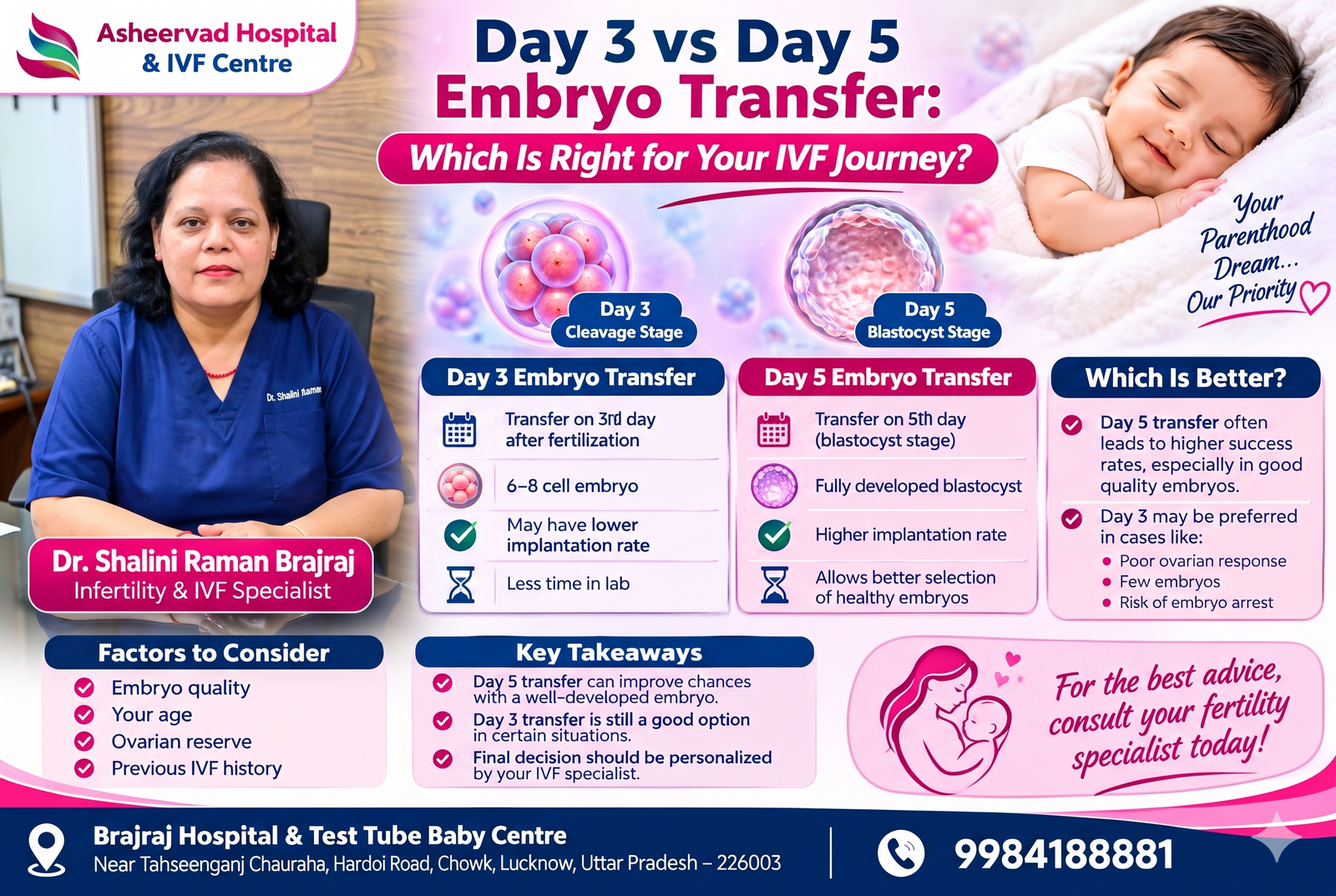
Day 3 vs Day 5 Embryo Transfer: Which Is Right for Your IVF Journey?
SEO Title: Day 3 vs Day 5 Embryo Transfer: IVF Guide in Lucknow
Meta Description: Understand the difference between Day 3 and Day 5 embryo transfer, blastocyst development, benefits, limitations and how doctors decide the right IVF approach.
Focus Keyword: Day 5 Embryo Transfer Lucknow
Secondary Keywords: Blastocyst transfer, Day 3 embryo transfer, IVF embryo development, blastocyst culture, IVF treatment Lucknow, embryo transfer process.
Day 3 vs Day 5 Embryo Transfer: Which Is Right for Your IVF Journey?
In an IVF treatment cycle, fertilisation takes place in a laboratory, where embryologists monitor the development of embryos before they are transferred into the uterus. One important decision during this process is the timing of embryo transfer.
Some embryos may be transferred on Day 3, while others are cultured until Day 5 or Day 6, when they may reach the blastocyst stage. Both approaches are used in fertility treatment, and the most suitable option depends on the individual couple’s medical circumstances.
For couples exploring Day 5 embryo transfer in Lucknow, understanding the difference between these stages can help make fertility consultations more informed.
What Is Embryo Transfer in IVF?
In vitro fertilisation (IVF) is a fertility treatment in which eggs are collected from the ovaries and fertilised with sperm in a laboratory. The fertilised eggs begin developing into embryos.
An embryologist observes the embryos and evaluates their development. Depending on the treatment plan, an embryo may be transferred into the uterus a few days after fertilisation or frozen for transfer in a later cycle.
Embryo transfer is generally performed using a thin catheter. The procedure is usually brief, and anaesthesia is not routinely required. The exact process may vary according to the patient’s treatment plan and clinical needs.
Understanding Day 3 Embryo Transfer
Day 3 embryo transfer is also known as cleavage-stage transfer.
By approximately Day 3 after fertilisation, a normally developing embryo has divided into several cells. The embryologist evaluates factors such as the number of cells, cell appearance and degree of fragmentation.
Possible Benefits of Day 3 Transfer
- The embryo is transferred earlier in its development.
- It may be considered when only a small number of embryos are available.
- It may reduce the risk of having no embryo available for transfer after extended laboratory culture.
- It can be an appropriate option in selected treatment circumstances.
Limitations of Day 3 Transfer
At this stage, embryos are still relatively early in development. The embryologist has less information about which embryos will continue developing into blastocysts.
However, Day 3 transfer should not be considered an inferior treatment in every situation. It may be suitable for patients whose embryo numbers, development pattern or clinical circumstances make earlier transfer a reasonable choice.
What Is Day 5 Embryo Transfer?
Day 5 embryo transfer is commonly called blastocyst transfer.
A blastocyst is a more developed embryo that has formed a fluid-filled cavity and specialised groups of cells. One group, called the inner cell mass, contributes to the development of the fetus. Another group, called the trophectoderm, contributes to the placenta.
Some embryos reach the blastocyst stage on Day 5, while others may require additional time and develop on Day 6.
Why Is Day 5 Important?
In natural conception, an embryo typically reaches the blastocyst stage around the time it enters the uterus. In IVF, laboratory culture allows embryologists to observe this developmental progress before transfer.
Extended culture may provide additional information about embryo development and help the embryology team select an embryo for transfer.
Possible Benefits of Blastocyst Transfer
- Embryos have been observed for a longer period.
- Embryo selection may be more informative in suitable cases.
- It may support single embryo transfer when an appropriate embryo is available.
- In selected patients, blastocyst transfer may improve the chance of live birth per transfer compared with earlier-stage transfer.
These potential benefits do not mean that Day 5 transfer is best for every patient. The overall chance of having a baby also depends on the number of embryos available, embryo quality, age and other fertility factors.
Day 3 vs Day 5 Embryo Transfer: Key Differences
| Feature | Day 3 Transfer | Day 5 Transfer |
|---|---|---|
| Embryo stage | Cleavage stage | Blastocyst stage |
| Development | Several cells | More developed structure with specialised cells |
| Laboratory observation | Shorter | Longer |
| Embryo selection | Based on early development | Additional developmental information |
| Suitable for | Selected patients, including some with few embryos | Often considered when embryos develop well and enough are available |
The decision should be based on the complete treatment picture rather than the transfer day alone.
Does Day 5 Transfer Always Have a Higher Success Rate?
Not necessarily.
Research suggests that blastocyst transfer may improve live-birth chances per fresh transfer in some patients, particularly those with a good prognosis and suitable embryo numbers. However, the evidence is not identical for every patient group.
One important consideration is that not all embryos continue developing to the blastocyst stage in the laboratory. In some cycles, there may be no embryo available for transfer or freezing by Day 5.
This does not automatically mean that an embryo would have resulted in pregnancy if transferred earlier. Nevertheless, it is a genuine limitation that should be discussed before choosing extended culture.
Doctors may consider:
- The patient’s age and fertility history
- Number of fertilised eggs
- Number and development of embryos
- Previous IVF outcomes
- The laboratory’s experience and culture conditions
- Whether fresh or frozen embryo transfer is planned
What Happens if an Embryo Does Not Reach Day 5?
Embryos develop at different rates. Some may stop developing before the blastocyst stage, while others may need an additional day to reach a suitable stage.
If no embryo reaches the stage required for transfer or freezing, the treatment team will explain the findings and discuss possible next steps.
This can be emotionally difficult for couples. It is important to remember that embryo development is influenced by many biological factors and is not something patients can control through ordinary daily activities.
Is Day 5 Transfer Suitable for Everyone?
No. The choice between Day 3 and Day 5 transfer should be individualised.
For example, when only a few embryos are available, the fertility team may discuss whether earlier transfer is more appropriate. When several embryos are developing well, extended culture may provide useful additional information.
There is no universal rule that every IVF patient must undergo Day 5 transfer. The best approach is the one that considers the patient’s medical situation, embryo development and treatment goals.
Frequently Asked Questions
1. Is Day 5 embryo transfer better than Day 3?
Day 5 transfer may offer advantages for selected patients, including more information about embryo development. However, it is not automatically better for every IVF cycle.
2. Can embryos reach the blastocyst stage on Day 6?
Yes. Some embryos reach the blastocyst stage on Day 6 and may be considered for transfer or freezing if they meet the laboratory’s criteria.
3. Does a Day 5 transfer guarantee pregnancy?
No. Embryo transfer does not guarantee implantation or pregnancy. Outcomes depend on several factors, including embryo characteristics and the patient’s reproductive health.
4. Is embryo transfer painful?
The procedure is usually brief and generally does not require anaesthesia. Some patients may experience mild discomfort, but individual experiences can vary.
5. How is the transfer day selected?
The fertility specialist and embryology team consider embryo development, the number of embryos available, the patient’s history and the planned treatment cycle.
Conclusion
Day 3 and Day 5 embryo transfers are both established approaches in IVF treatment. Day 5 blastocyst transfer allows embryos to develop for a longer period in the laboratory, providing additional information that may help with embryo selection. However, extended culture also carries the possibility that no embryo will reach a suitable stage for transfer.
For couples considering Day 5 embryo transfer in Lucknow, discussing the advantages and limitations of both approaches with a fertility specialist is an important part of treatment planning.
At Brajraj Hospital & Test Tube Baby Centre, couples can seek fertility consultation and guidance about IVF treatment options based on their individual circumstances.
Hospital Details
Brajraj Hospital & Test Tube Baby Centre
Address: Near Tahseenganj Chauraha, Hardoi Road, Chowk, Lucknow, Uttar Pradesh – 226003
Phone: 9984188881
Website: https://brajrajhospital.com/
Medical Disclaimer: This article is for general educational purposes only and does not replace professional medical advice, diagnosis or treatment. IVF and embryo transfer decisions should be made with a qualified fertility specialist after individual evaluation.