

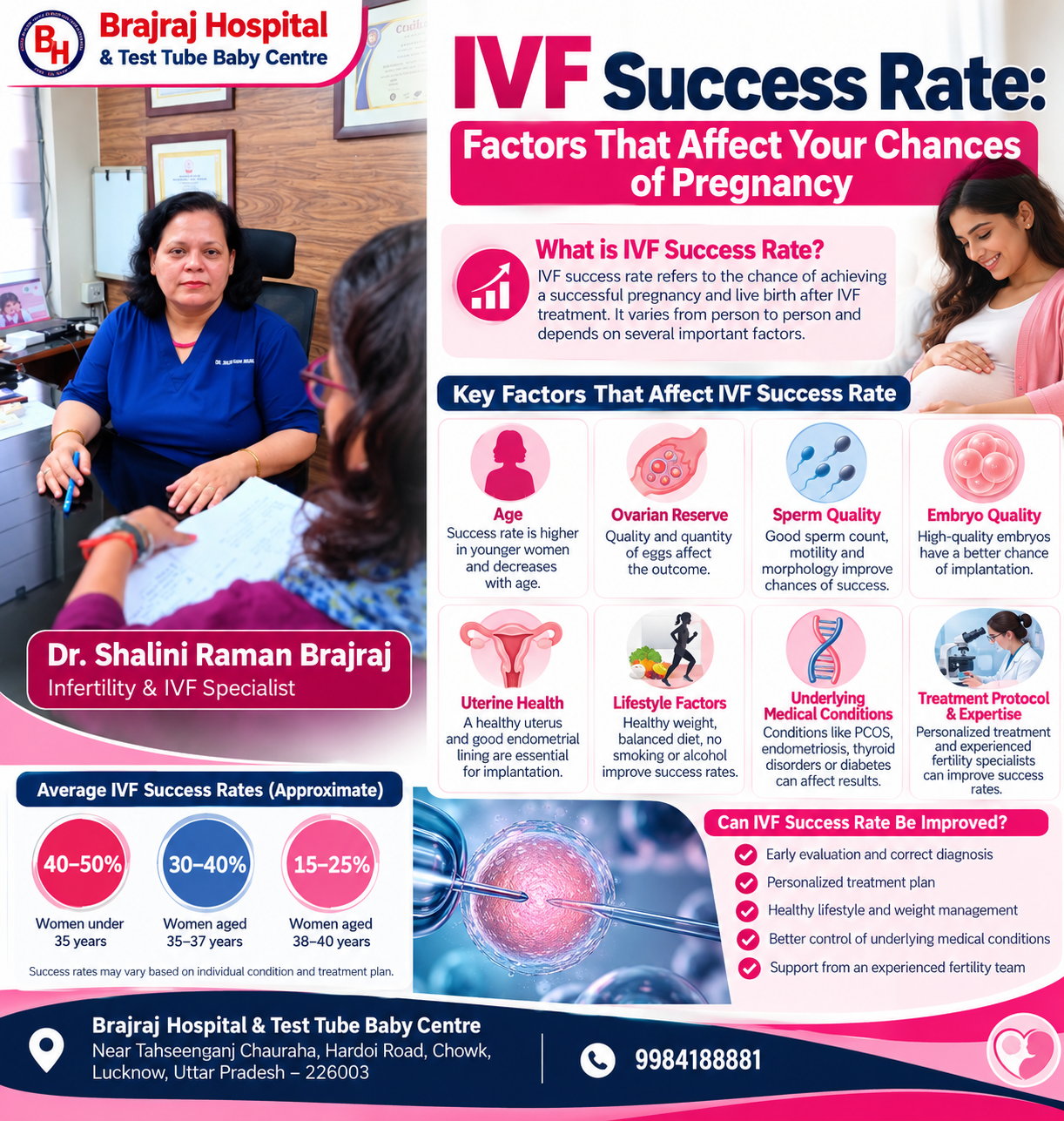
IVF Success Rate: Factors That Affect Your Chances of Pregnancy
SEO Title: IVF Success Rate in Lucknow: Factors That Affect Pregnancy
Meta Description: Understand IVF success rates, how age and embryo quality affect outcomes, what to expect during treatment, and questions to ask your fertility specialist in Lucknow.
Focus Keyword: IVF success rate Lucknow
Secondary Keywords: IVF treatment success rate, IVF pregnancy chances, factors affecting IVF success, embryo quality, IVF treatment in Lucknow, fertility specialist Lucknow
Introduction
For couples experiencing difficulty conceiving, in vitro fertilisation (IVF) can offer an additional path toward pregnancy. One of the most common questions before beginning treatment is: “What are my chances of success?”
The answer depends on several factors, including the age of the person providing the eggs, the cause of infertility, embryo development, uterine health, and the clinic’s treatment approach. There is no single success rate that accurately predicts the outcome for every couple.
Understanding the factors that influence the IVF success rate in Lucknow can help patients prepare for treatment, ask informed questions, and develop realistic expectations.
What Does IVF Success Rate Mean?
IVF success can be measured in different ways, and understanding the difference is important when comparing statistics.
- Positive pregnancy test: A blood or urine test detects the pregnancy hormone hCG.
- Clinical pregnancy: A pregnancy is confirmed through ultrasound findings, such as a gestational sac.
- Live birth: Treatment results in the birth of a living baby.
- Cumulative success rate: The chance of achieving an outcome across multiple treatment attempts or transfers, depending on how the statistic is defined.
These outcomes are not interchangeable. A positive pregnancy test does not always lead to an ongoing pregnancy or live birth.
When discussing success rates with a fertility clinic, ask which outcome is being reported, whether the figure is per treatment cycle or embryo transfer, and whether it applies to patients with a similar age and medical history.
7 Factors That Affect IVF Success
1. Age of the Person Providing the Eggs
Age is one of the most important factors affecting IVF outcomes when using a person’s own eggs.
As age increases, the number of eggs available and the proportion of eggs with chromosomal abnormalities generally change. These factors can influence fertilisation, embryo development, miscarriage risk, and the likelihood of live birth.
This does not mean that pregnancy is impossible at an older age. Rather, age helps the specialist estimate the likely response to treatment and discuss suitable options.
2. Egg Quality and Ovarian Reserve
Ovarian reserve refers to the remaining supply of eggs in the ovaries. Tests such as anti-Müllerian hormone (AMH), antral follicle count, and sometimes follicle-stimulating hormone (FSH) help doctors estimate ovarian response to stimulation.
These tests can help plan medication and anticipate how many eggs may be retrieved. However, ovarian reserve tests do not directly measure egg quality and cannot predict an individual’s chance of pregnancy with certainty.
3. Sperm Health
Sperm count, movement, and shape can influence fertility and treatment planning. A semen analysis is commonly used to assess these parameters.
Depending on the findings, the fertility specialist may recommend conventional IVF or intracytoplasmic sperm injection (ICSI), in which a single sperm is injected directly into a mature egg.
ICSI is useful in selected situations, particularly certain male-factor infertility cases, but it is not automatically necessary for every IVF cycle.
4. Embryo Development and Quality
After fertilisation, embryos are monitored in the laboratory. Their development and appearance help embryologists assess which embryos may be suitable for transfer or freezing.
Some embryos stop developing before reaching the blastocyst stage, while others continue to develop but may still have chromosomal abnormalities.
Embryo appearance can provide useful information, but it cannot guarantee implantation or a successful pregnancy. The specialist will consider the available embryos and the patient’s circumstances when recommending a transfer strategy.
5. Uterine Health
The uterus needs to be suitable for implantation and pregnancy. Certain uterine conditions, including some fibroids, polyps, or adhesions, may affect treatment depending on their location and severity.
A specialist may recommend an ultrasound or other targeted investigations when indicated. Not every patient requires extensive uterine testing, and treatment should be based on the findings rather than routine procedures without a clear reason.
6. Cause and Duration of Infertility
IVF outcomes may differ depending on whether infertility is related to blocked fallopian tubes, ovulation problems, endometriosis, male-factor infertility, unexplained infertility, or a combination of factors.
Previous pregnancy history and earlier fertility treatment results may also help guide planning. A complete assessment of both partners can help identify relevant issues and avoid focusing on only one possible cause.
7. Treatment Plan and Laboratory Conditions
The stimulation protocol, response to medication, timing of egg retrieval, embryo culture, and transfer strategy can all influence the treatment process.
Fertility care should be individualised. More medication, a larger number of retrieved eggs, or a particular transfer day does not automatically guarantee a better outcome.
The clinic’s laboratory standards and clinical practices are also important considerations when choosing where to receive treatment.
How Can You Prepare for IVF Treatment?
Although not every factor affecting IVF is under a person’s control, preparation can support general health and help the treatment team plan appropriately.
Attend a complete fertility assessment. Share your medical history, previous treatment records, medication list, and any relevant test results with the specialist.
Follow the prescribed treatment plan. Take fertility medicines according to instructions and attend monitoring appointments. Do not change doses independently.
Support your general health. Avoid smoking and recreational drugs, limit alcohol as advised, maintain a balanced diet, and aim for a healthy weight where possible.
Review medicines and supplements. Discuss prescription medicines, over-the-counter products, and supplements with your doctor before starting or stopping them.
Ask about emotional support. Fertility treatment can involve uncertainty and stress. Counselling, partner support, and clear communication with the clinic may help you navigate the process.
Healthy habits can support overall well-being, but no diet, supplement, or lifestyle routine can guarantee IVF success.
Does Day-5 Embryo Transfer Improve IVF Success?
During IVF, embryos may be transferred at an earlier cleavage stage or after developing into blastocysts, usually on Day 5 or Day 6.
Blastocyst culture allows the embryology team to observe embryos for longer before selecting one for transfer. In appropriately selected patients, this may improve embryo selection and pregnancy outcomes per transfer.
However, not every embryo reaches the blastocyst stage. Patients with fewer embryos may face a higher risk of having no embryo available for transfer if extended culture is chosen.
The best approach depends on the number of developing embryos, previous treatment history, prognosis, and laboratory practices. Day-5 transfer is not automatically the best choice for everyone.
How Many IVF Cycles Might Be Needed?
Some patients achieve pregnancy during their first IVF cycle, while others need additional treatment attempts. Some may not achieve pregnancy despite several cycles.
The number of attempts depends on age, the underlying diagnosis, ovarian response, embryo availability, and the outcome of previous treatment.
A specialist may review the results after each cycle and adjust the treatment plan if appropriate. This may include reassessing the diagnosis, reviewing fertilisation results, or discussing whether another treatment approach would be more suitable.
Before beginning IVF, ask about the likely treatment timeline, the possibility of frozen embryo transfer, the costs of additional cycles, and the options available if the first attempt is unsuccessful.
Questions to Ask Your Fertility Specialist
Before starting treatment, consider asking:
- Which success measure is most relevant to my situation: pregnancy rate or live-birth rate?
- How does my age and ovarian reserve affect the treatment plan?
- What are the possible reasons IVF may not succeed in my case?
- Is conventional IVF or ICSI recommended, and why?
- What happens if no suitable embryo is available for transfer?
- What is included in the quoted treatment cost?
- What would be the next step if this cycle is unsuccessful?
These questions can help you understand the treatment process and make decisions based on your individual needs rather than a general percentage.
Frequently Asked Questions
1. What is a good IVF success rate?
A meaningful success rate depends on age, diagnosis, treatment history, and the outcome being measured. Ask the clinic for statistics relevant to patients with a similar profile.
2. Can IVF succeed on the first attempt?
Yes, some patients achieve pregnancy during their first cycle, while others require further attempts. No individual outcome can be guaranteed.
3. Does a high AMH level guarantee IVF success?
No. AMH helps estimate ovarian response, but it does not independently determine egg quality, embryo development, or live-birth chances.
4. Does a good-quality embryo guarantee pregnancy?
No. Embryo appearance is one part of the assessment. Implantation and pregnancy depend on several additional factors.
5. Can lifestyle changes improve IVF outcomes?
Healthy habits may support general reproductive health, but their effects vary. They cannot eliminate all causes of infertility or guarantee a successful cycle.
Conclusion
IVF success depends on several interconnected factors, including age, egg and sperm health, embryo development, uterine conditions, and the underlying cause of infertility. Understanding these factors can help couples set realistic expectations and make informed decisions.
If you are exploring the IVF success rate in Lucknow, consult a qualified fertility specialist who can review both partners’ evaluations and explain the most relevant outcome measures for your circumstances.
The aim is not simply to pursue a higher percentage, but to choose a safe, evidence-based treatment plan suited to your reproductive goals.
Medical disclaimer: This article is for general educational purposes only and does not replace personalised medical advice, diagnosis, or treatment.
Hospital Details
Brajraj Hospital & Test Tube Baby Centre
Address: Near Tahseenganj Chauraha, Hardoi Road, Chowk, Lucknow, Uttar Pradesh – 226003
Phone: 9984188881
Website: https://brajrajhospital.com/
Contact the hospital to confirm current consultation availability and the fertility services offered.