

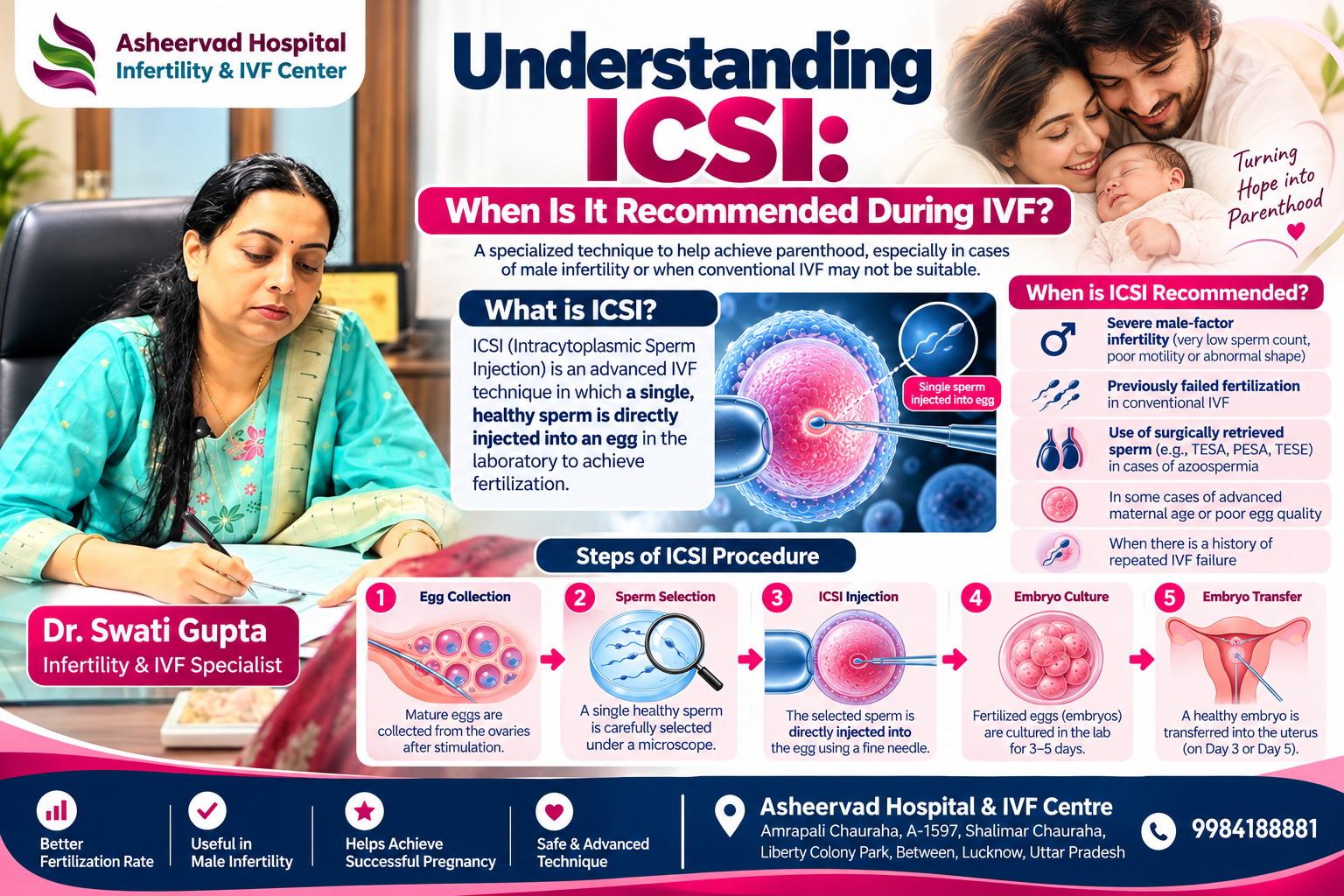
Understanding ICSI: When Is It Recommended During IVF?
SEO Title: ICSI Treatment in Lucknow: When Is It Recommended During IVF?
Meta Description: Understand ICSI treatment, how it works, when doctors recommend it during IVF, its benefits, risks, and how it differs from conventional IVF.
Focus Keyword: ICSI treatment Lucknow
Secondary Keywords: ICSI procedure, IVF with ICSI, intracytoplasmic sperm injection, male infertility treatment, low sperm count treatment, fertility specialist in Lucknow
Introduction
For couples experiencing difficulty conceiving, in vitro fertilisation (IVF) can provide an additional route to parenthood. One specialised technique used during some IVF cycles is Intracytoplasmic Sperm Injection, commonly known as ICSI.
ICSI is a laboratory procedure in which an embryologist injects a single sperm directly into a mature egg. It is often considered when there are significant sperm-related fertility problems or when previous IVF treatment has resulted in very low or no fertilisation.
However, ICSI is not necessary for every couple undergoing IVF. The decision depends on the medical history, sperm quality, previous treatment results, and the fertility specialist’s assessment.
If you are researching ICSI treatment in Lucknow, understanding the procedure and its potential benefits can help you prepare for an informed discussion with your doctor.
What Is ICSI Treatment?
ICSI stands for Intracytoplasmic Sperm Injection. It is a specialised fertilisation technique performed in an embryology laboratory as part of an IVF cycle.
During conventional IVF, prepared sperm and eggs are placed together in a laboratory dish so that fertilisation can occur. With ICSI, the embryologist selects one sperm and injects it directly into a mature egg using specialised microscopic equipment.
This technique bypasses some of the steps sperm would normally need to complete to fertilise an egg. However, it does not guarantee fertilisation, healthy embryo development, implantation, or pregnancy.
ICSI is a method of fertilisation within IVF, rather than a completely separate treatment journey.
When Is ICSI Recommended?
1. Very Low Sperm Count
A significantly low sperm count may reduce the likelihood of fertilisation through conventional IVF. ICSI allows an embryologist to select an individual sperm for injection into each suitable mature egg.
It may be recommended in selected cases of severe male-factor infertility after appropriate assessment.
2. Poor Sperm Motility
Sperm motility describes how effectively sperm move. Reduced motility may make it harder for sperm to reach and fertilise an egg.
ICSI bypasses the need for sperm to travel to and penetrate the egg independently. Nevertheless, the sperm must still be suitable for injection, and successful fertilisation cannot be guaranteed.
3. Previous Fertilisation Failure
If a previous IVF cycle resulted in very low or no fertilisation, the specialist may consider ICSI for a subsequent cycle.
The doctor should review the previous cycle’s findings before recommending a change. The cause may involve sperm, egg characteristics, or other factors, so ICSI is not automatically the right solution in every case.
4. Surgically Retrieved Sperm
Some men have no sperm in their ejaculate because of a blockage or a sperm-production problem. In selected cases, sperm can be retrieved from the epididymis or testicle through a medical procedure.
ICSI is commonly considered when suitable sperm is obtained this way because the sample may be limited or unsuitable for conventional IVF.
5. Selected Cases Using Frozen Eggs
ICSI may be considered when previously frozen eggs are thawed for treatment. The freezing and thawing process can affect the egg’s outer layer, which may influence the choice of fertilisation technique.
The fertility team will decide whether ICSI is appropriate based on the treatment circumstances and laboratory protocols.
How Does the ICSI Procedure Work?
ICSI usually takes place as part of an IVF cycle and involves the following stages.
Step 1: Fertility assessment
The doctor reviews the medical history of both partners and recommends appropriate investigations. These may include semen analysis, hormone tests, and ultrasound examinations.
Step 2: Ovarian stimulation
Medication may be prescribed to stimulate the ovaries to develop multiple follicles. The response is monitored through ultrasound and, when appropriate, blood tests.
Step 3: Egg retrieval
When the follicles are ready, eggs are collected through a procedure performed under appropriate medical supervision.
Step 4: Sperm preparation
The laboratory prepares the sperm sample and identifies suitable sperm. If sperm has been surgically retrieved, the embryology team assesses the available sample.
Step 5: Sperm injection
An embryologist injects one selected sperm into each suitable mature egg using specialised equipment.
Step 6: Fertilisation assessment
The laboratory checks whether normal fertilisation has occurred. Not every injected egg will fertilise successfully.
Step 7: Embryo development
Fertilised eggs are monitored as they develop. Depending on the treatment plan, a suitable embryo may be transferred into the uterus or frozen for a future cycle.
Step 8: Pregnancy testing
A pregnancy test is performed at the time advised by the fertility clinic. If the result is positive, further monitoring is arranged.
Benefits of ICSI Treatment
ICSI can provide important benefits when there is a clear clinical reason to use it.
- Helps address selected sperm-related problems: It bypasses some of the barriers involved in sperm reaching and penetrating the egg.
- Uses an individual sperm: A suitable sperm can be selected for injection into each mature egg.
- May help after previous fertilisation failure: It can be considered when a previous conventional IVF cycle resulted in very low or no fertilisation.
- Can be used with surgically retrieved sperm: It offers a fertilisation option in selected cases where sperm is collected directly from the reproductive tract.
The main benefit is improving the chance of fertilisation in appropriately selected cases. It does not remove every cause of infertility or guarantee a successful pregnancy.
ICSI vs Conventional IVF
| Feature | Conventional IVF | ICSI |
|---|---|---|
| Fertilisation method | Eggs and prepared sperm are placed together | One sperm is injected directly into a mature egg |
| Common indication | Suitable cases without a specific ICSI indication | Selected male-factor or fertilisation-related problems |
| Sperm penetration | Sperm must penetrate the egg independently | Injection bypasses this step |
| Laboratory technique | Standard IVF fertilisation | Specialised microscopic procedure |
| Pregnancy guaranteed? | No | No |
Neither method is universally better. The appropriate choice depends on the diagnosis and whether ICSI is likely to provide a meaningful benefit.
Risks and Limitations of ICSI
Although ICSI is an established technique, it has limitations that patients should understand.
Fertilisation may still fail. Injecting a sperm into an egg does not guarantee normal fertilisation.
Not every embryo continues developing. Some fertilised eggs stop developing before reaching a stage suitable for transfer.
Egg damage is possible. The injection procedure can damage some eggs, even when performed by trained embryology professionals.
Pregnancy is not guaranteed. Embryo development, age, uterine health, and other reproductive factors influence outcomes.
Genetic counselling may be appropriate in selected cases. Certain causes of severe male infertility may be associated with genetic conditions. A specialist may recommend additional testing depending on the diagnosis.
Before treatment, ask the fertility team about the expected benefits, potential risks, alternatives, and the likely costs for your particular situation.
What Factors Affect ICSI Outcomes?
Treatment outcomes vary between individuals. Important factors include:
- Age of the female partner.
- Number and maturity of retrieved eggs.
- Sperm quality and the cause of infertility.
- Embryo development and laboratory conditions.
- Uterine health and other reproductive factors.
- Previous fertility treatment history.
Success rates should be interpreted carefully. Fertilisation rate, clinical pregnancy rate, and live-birth rate describe different stages and outcomes of treatment.
A fertility specialist can explain which measures are most relevant to your circumstances rather than relying on a general percentage.
What Is the Cost of ICSI Treatment in Lucknow?
The cost of ICSI treatment varies by clinic and individual treatment requirements. It may depend on medication, investigations, egg retrieval, laboratory procedures, embryo freezing, and whether additional services are needed.
Some clinics include ICSI in an IVF package, while others charge separately. There is no single price that applies to every patient.
Before starting treatment, request a written estimate that explains what is included, which services cost extra, and what additional expenses may arise if another cycle or frozen embryo transfer is needed.
Frequently Asked Questions
1. Is ICSI better than conventional IVF?
ICSI can be beneficial for selected cases, particularly certain male-factor infertility problems. It is not necessarily better for every patient, and conventional IVF remains appropriate in many cases.
2. Does ICSI guarantee fertilisation?
No. ICSI allows a selected sperm to be injected directly into a mature egg, but fertilisation may still fail.
3. Is ICSI painful?
The injection itself is performed on the egg in the laboratory, not inside the patient’s body. However, the overall IVF cycle includes procedures such as egg retrieval, which may involve sedation or anaesthesia.
4. Can ICSI help when the sperm count is extremely low?
It may be an option in selected cases. The specialist must assess sperm availability, quality, and the underlying cause.
5. Is ICSI required for every IVF cycle?
No. The choice should be based on the patient’s clinical findings and a discussion with the fertility specialist.
Conclusion
ICSI is an important assisted reproductive technique that may help couples facing certain male-factor infertility problems or previous fertilisation difficulties. It involves injecting a single sperm directly into a mature egg and can improve the chance of fertilisation in appropriately selected cases.
However, ICSI is not necessary for every IVF cycle and cannot guarantee pregnancy. A personalised fertility assessment is essential to determine whether conventional IVF, ICSI, or another approach is most suitable.
If you are considering ICSI treatment in Lucknow, consult a qualified fertility specialist to discuss your test results, treatment options, possible risks, and expected costs.
Medical disclaimer: This article is intended for general educational purposes only and does not replace personalised medical advice, diagnosis, or treatment.
Hospital Details
Asheervad Hospital & IVF Centre
Address: Amrapali Chauraha, A-1597, Shalimar Chauraha, Liberty Colony Park, between, Indira Nagar, Lucknow – 226016
Phone: 080044 3394
Consultant: Dr. Swati Gupta – Consultant Obstetrician, Gynecologist & Infertility Specialist
Contact the hospital to confirm current consultation availability and the specific ICSI services offered.