

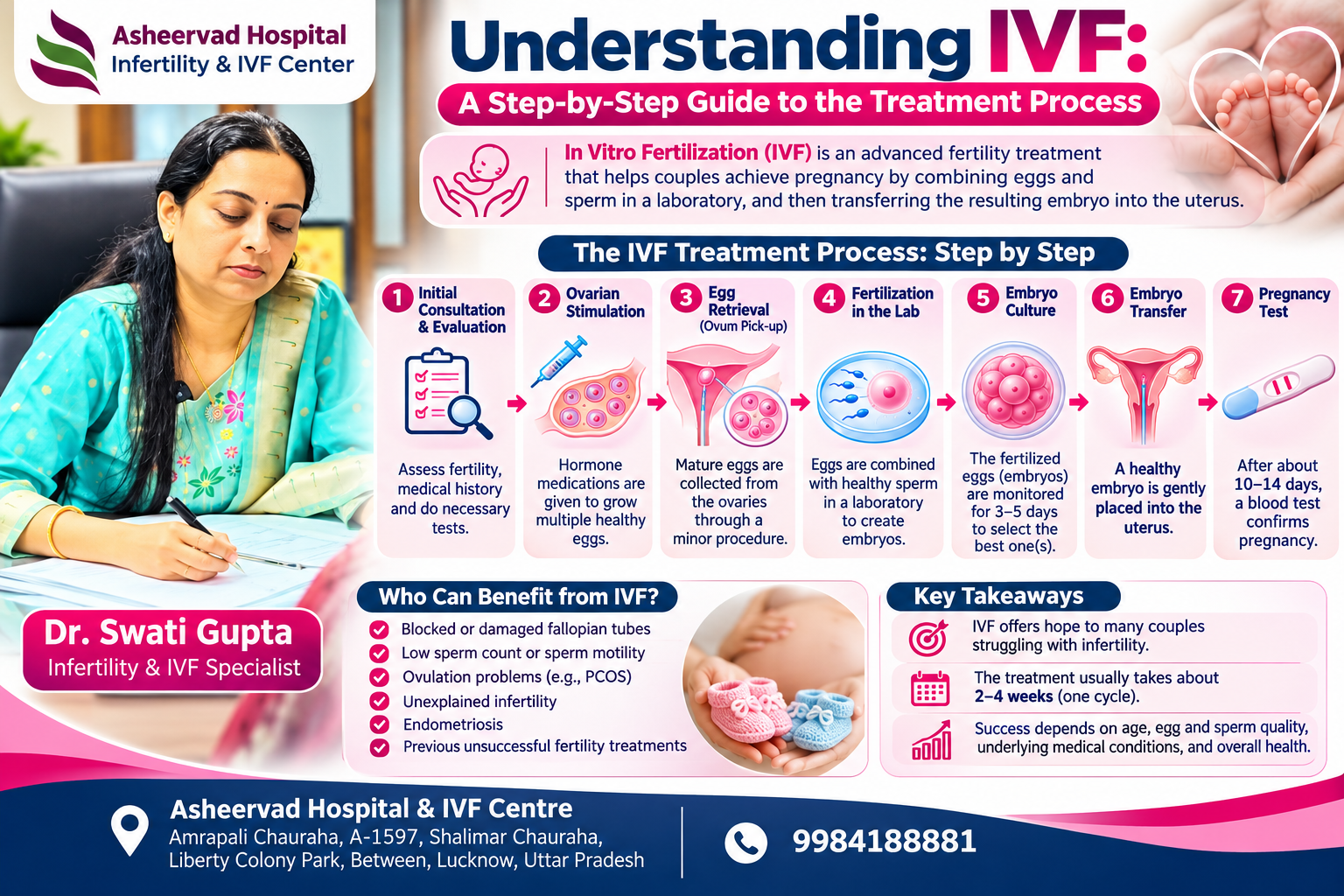
Understanding IVF: A Step-by-Step Guide to the Treatment Process
SEO Title: IVF Treatment in Lucknow: Step-by-Step Process Explained
Meta Description: Learn how IVF treatment works, from fertility testing and ovarian stimulation to egg retrieval, embryo transfer, and pregnancy testing.
Focus Keyword: IVF treatment in Lucknow
Secondary Keywords: IVF process, IVF treatment steps, infertility treatment Lucknow, embryo transfer, fertility specialist Lucknow
Introduction
For many couples facing infertility, In Vitro Fertilisation (IVF) can provide an important treatment option. IVF is one of the most widely known forms of assisted reproductive technology and has helped many individuals and couples pursue their goal of having a baby.
However, beginning IVF treatment can feel overwhelming. There are medical tests, medications, laboratory procedures, appointments, and important decisions throughout the process. Understanding each stage can help patients feel more prepared and make informed decisions with their fertility specialist.
This guide explains the IVF process step by step, including fertility assessment, ovarian stimulation, egg retrieval, fertilisation, embryo development, embryo transfer, and pregnancy testing.
If you are considering IVF treatment in Lucknow, it is important to remember that every treatment plan is individual. The exact process may vary according to age, medical history, the cause of infertility, and the recommendations of the treating fertility specialist.
What Is IVF?
IVF stands for In Vitro Fertilisation. The term “in vitro” refers to a process that takes place outside the body in a laboratory.
During IVF, eggs are collected from the ovaries and fertilised with sperm in a specialised embryology laboratory. The resulting embryos are monitored as they develop. A suitable embryo may then be transferred into the uterus or frozen for possible future use.
IVF may be considered for several fertility-related conditions, including:
- Blocked or severely damaged fallopian tubes.
- Certain male-factor infertility problems.
- Endometriosis.
- Ovulation disorders when other treatments have not been successful.
- Unexplained infertility in selected circumstances.
- Previous unsuccessful fertility treatments.
The decision to begin IVF should be based on a complete fertility evaluation and a discussion with a qualified specialist.
Step 1: Initial Fertility Assessment
Before starting IVF, the doctor usually reviews the medical and reproductive history of both partners.
The assessment may include questions about:
- Menstrual cycles.
- Previous pregnancies.
- Previous fertility treatment.
- Medical conditions and surgeries.
- Medications.
- Lifestyle factors that may affect reproductive health.
Depending on the situation, the doctor may recommend tests such as ultrasound examinations, hormone tests, ovarian reserve assessment, and semen analysis.
The purpose of this assessment is to understand the possible causes of infertility and create an appropriate treatment plan.
Both partners should usually be evaluated because fertility difficulties can involve female factors, male factors, or a combination of both.
Step 2: Ovarian Stimulation
During a natural menstrual cycle, the ovaries usually release one mature egg. During an IVF cycle, fertility medications may be used to encourage the development of multiple follicles.
Each follicle may contain an egg.
The medication protocol is personalised according to factors such as age, ovarian reserve, medical history, and previous treatment response.
During this stage, the fertility team monitors the ovaries using ultrasound scans and, when appropriate, blood tests.
Regular monitoring helps the doctor understand how the ovaries are responding and decide when the eggs are ready for collection.
Patients should take medications exactly as prescribed and should not change the dosage without consulting the fertility team.
Step 3: Trigger Injection
When the developing follicles reach an appropriate stage, the doctor may prescribe a final medication known as a trigger injection.
This medication helps complete the final stages of egg maturation before egg retrieval.
Timing is important because the egg retrieval procedure is scheduled according to the treatment protocol.
The fertility clinic will provide clear instructions about when and how to take the medication and when to arrive for the procedure.
Step 4: Egg Retrieval
Egg retrieval is the procedure used to collect eggs from the ovaries.
The procedure is generally performed under appropriate sedation or anaesthesia. Using ultrasound guidance, the doctor collects fluid from the ovarian follicles, and the embryology laboratory examines the fluid to identify the eggs.
The procedure itself is usually completed within a relatively short time, although patients may need to spend additional time at the clinic for preparation and recovery.
Some patients experience mild cramping or discomfort afterwards. The fertility team will provide instructions about recovery and symptoms that require medical attention.
The number of eggs retrieved can vary significantly between patients and between treatment cycles.
Importantly, retrieving a larger number of eggs does not guarantee pregnancy.
Step 5: Sperm Collection and Preparation
A sperm sample is usually collected and prepared on or around the day of egg retrieval.
The embryology laboratory processes the sample and evaluates the sperm according to the treatment plan.
Depending on the couple’s fertility diagnosis, fertilisation may take place through:
Conventional IVF
Prepared sperm and eggs are placed together in a laboratory environment to allow fertilisation to occur.
ICSI
Intracytoplasmic Sperm Injection, or ICSI, involves injecting a single sperm directly into a mature egg.
ICSI may be recommended in selected cases, particularly when significant sperm-related fertility problems are present or when there has been previous fertilisation failure.
The fertility specialist and embryology team determine the most appropriate fertilisation method based on individual clinical findings.
Step 6: Fertilisation and Embryo Development
After the eggs and sperm are combined, the embryology team monitors the fertilisation process.
Not every egg will fertilise successfully. Similarly, not every fertilised egg will continue developing into an embryo suitable for transfer or freezing.
Embryos can be cultured in the laboratory for several days.
Some may be transferred at an earlier stage, while others may continue developing to the blastocyst stage, usually around Day 5 or Day 6.
The decision regarding embryo culture and transfer timing depends on several factors, including:
- The number of developing embryos.
- Embryo development.
- Previous treatment history.
- The patient’s individual prognosis.
- Laboratory and clinical protocols.
Reaching a particular developmental stage does not guarantee implantation or pregnancy.
Step 7: Embryo Transfer
Embryo transfer is one of the final stages of an IVF cycle.
A suitable embryo is placed inside the uterus using a thin catheter. The procedure generally does not require surgery.
The fertility specialist decides the transfer strategy based on the patient’s age, embryo development, medical history, and other relevant factors.
In some cases, the best option may be to freeze embryos and plan the transfer in a later cycle.
A single embryo transfer may be recommended in appropriate circumstances to reduce the risk of multiple pregnancy.
Transferring more than one embryo can increase the possibility of twins or higher-order multiple pregnancies, which may carry additional health risks.
Step 8: The Waiting Period and Pregnancy Test
After embryo transfer, patients enter the period commonly known as the “two-week wait.”
The fertility clinic will advise when to take a pregnancy test.
It is important not to test too early because results may be difficult to interpret, particularly if certain fertility medications have been used.
If the pregnancy test is positive, the clinic may arrange further blood tests or an ultrasound at the appropriate stage.
A positive pregnancy test is an encouraging step, but ongoing medical monitoring remains important.
What Factors Affect IVF Success?
IVF outcomes vary from person to person. Several factors can influence the likelihood of pregnancy.
Age
Age is an important factor, particularly when using a person’s own eggs. As age increases, egg quantity and the likelihood of chromosomal abnormalities can change.
Cause of Infertility
IVF outcomes can vary depending on whether infertility involves the fallopian tubes, ovulation, sperm quality, endometriosis, unexplained infertility, or multiple factors.
Egg and Sperm Factors
Egg maturity, sperm characteristics, and fertilisation can influence embryo development.
Embryo Development
Not all embryos develop in the same way. Embryologists assess embryos using established laboratory criteria, but embryo appearance cannot guarantee pregnancy.
Uterine Health
The condition of the uterus and uterine lining can also be important when planning embryo transfer.
Because so many factors are involved, a general success percentage cannot accurately predict an individual patient’s outcome.
Fresh vs Frozen Embryo Transfer
A fresh embryo transfer takes place during the same treatment cycle as egg retrieval.
A frozen embryo transfer involves freezing suitable embryos and transferring one during a later cycle.
The most appropriate option depends on the patient’s medical condition and treatment plan.
A specialist may recommend freezing embryos for several reasons, including the patient’s response to ovarian stimulation or the need to prepare the uterine environment for a future transfer.
Neither approach is automatically the best for every patient.
Questions to Ask Before Starting IVF
Before beginning treatment, consider discussing the following questions with your fertility specialist:
- Why is IVF recommended in my situation?
- What tests are needed before treatment?
- What medication protocol is being recommended?
- Is conventional IVF or ICSI more appropriate, and why?
- How many appointments may be required?
- What happens to suitable embryos that are not transferred?
- What are the possible risks and side effects?
- What costs are included in the treatment plan?
- What happens if the first cycle is unsuccessful?
Clear communication can help patients understand their options and prepare for the treatment journey.
Frequently Asked Questions
Is IVF painful?
Some parts of IVF, such as injections and egg retrieval, may involve discomfort. The egg retrieval procedure is generally performed with appropriate pain management or sedation.
How long does an IVF cycle take?
The timeline varies according to the treatment protocol and individual response. Your fertility clinic can provide a more accurate schedule for your specific treatment plan.
Does IVF guarantee pregnancy?
No. IVF can improve the chance of pregnancy for selected fertility problems, but no treatment can guarantee a successful outcome.
Is ICSI the same as IVF?
No. ICSI is a specialised fertilisation technique that may be used as part of an IVF cycle.
Can embryos be frozen?
Suitable embryos may be frozen for future use according to the treatment plan and applicable medical and legal requirements.
Conclusion
IVF is a multi-step fertility treatment that involves careful planning, medical monitoring, laboratory expertise, and personalised care. From the initial fertility assessment to embryo transfer, every stage is designed around the individual’s medical needs.
Understanding the process can help reduce uncertainty and allow couples to ask the right questions before beginning treatment.
If you are considering IVF treatment in Lucknow, consult a qualified fertility specialist for a complete evaluation. A personalised treatment plan can help determine whether IVF is appropriate and explain the potential benefits, limitations, risks, and expected treatment journey.
Medical Disclaimer: This article is intended for general educational purposes only and should not replace personalised medical advice, diagnosis, or treatment. Always consult a qualified fertility specialist regarding your individual circumstances.
Hospital Details
Asheervad Hospital & IVF Centre
Address: Amrapali Chauraha, A-1597, Shalimar Chauraha, Liberty Colony Park, Between, Indira Nagar, Lucknow – 226016
Phone: 080044 3394
Consultant: Dr. Swati Gupta – Consultant Obstetrician, Gynecologist & Infertility Specialist
For personalised fertility guidance, please contact the hospital to confirm current consultation availability and services.