

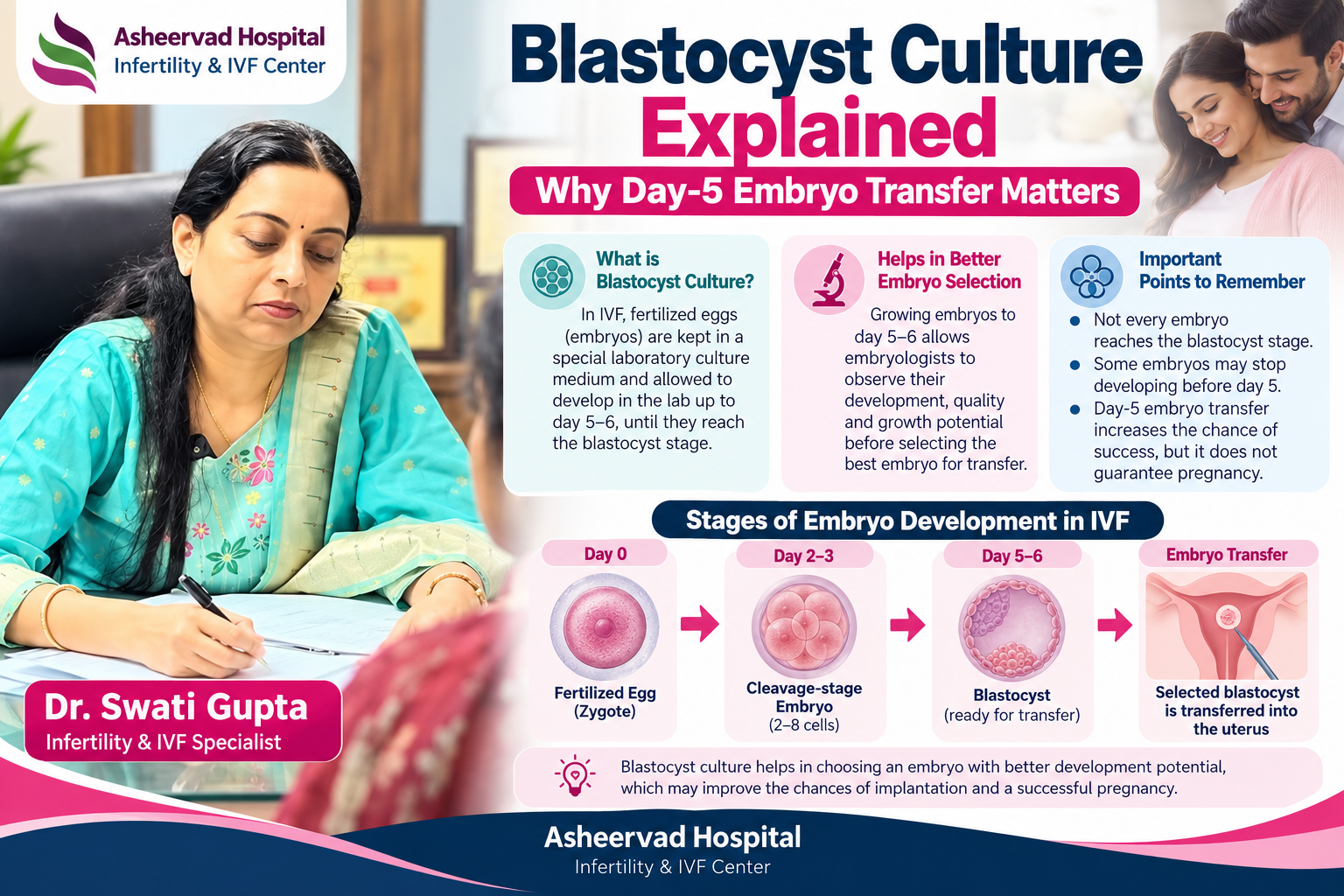
Blastocyst Culture Explained: Why Day-5 Embryo Transfer Matters
SEO Title: Blastocyst Culture IVF: Benefits of Day-5 Embryo Transfer
Meta Description: Learn what blastocyst culture is, how Day-5 embryo transfer works, its benefits, limitations, and how doctors decide whether it is suitable during IVF treatment.
Focus Keyword: blastocyst culture IVF
Secondary Keywords: Day-5 embryo transfer, blastocyst transfer, IVF treatment in Lucknow, embryo development, embryo implantation, frozen embryo transfer, fertility specialist in Lucknow
Introduction
For couples undergoing in vitro fertilisation (IVF), embryo transfer is one of the most important stages of treatment. Before an embryo is transferred into the uterus, it develops in a specialised laboratory under carefully controlled conditions.
One approach used during IVF is blastocyst culture, in which embryos are allowed to develop for approximately five or six days after fertilisation. When an embryo reaches the blastocyst stage, the embryologist can assess its development and help the fertility specialist select an embryo for transfer.
Day-5 embryo transfer is commonly discussed in modern fertility treatment because it allows embryos to develop for longer before selection. However, it is important to understand that this approach is not automatically the best choice for every patient.
If you are researching blastocyst culture IVF in Lucknow, this guide explains the process, potential benefits, limitations, and questions to discuss with a fertility specialist.
What Is Blastocyst Culture?
Blastocyst culture is a laboratory technique used during IVF in which fertilised eggs are allowed to develop beyond the early cleavage stage.
After fertilisation, an embryo passes through several developmental stages:
- Day 1: Fertilisation is assessed.
- Day 2–3: The embryo usually develops through early cell divisions.
- Day 5–6: Some embryos develop into blastocysts, a more advanced stage of development.
A blastocyst has a fluid-filled cavity and two main groups of cells:
- Inner cell mass: The group of cells that develops into the fetus.
- Trophectoderm: The outer group of cells that contributes to the placenta and supporting tissues.
Not every fertilised egg reaches this stage. Some embryos stop developing during laboratory culture, which is an important consideration when planning treatment.
The American Society for Reproductive Medicine (ASRM) explains that extended embryo culture can support embryo selection but also carries a greater risk of having no embryo available for transfer in some patients.
What Is Day-5 Embryo Transfer?
Day-5 embryo transfer is a procedure in which a suitable blastocyst is transferred into the uterus approximately five days after fertilisation.
In an IVF cycle, eggs are collected after ovarian stimulation and fertilised in the laboratory. The resulting embryos are monitored by embryologists. If an embryo develops to the blastocyst stage and is considered suitable, the fertility team may recommend transferring it.
The transfer itself usually involves passing a thin catheter through the cervix and placing the embryo inside the uterus. It generally does not require a surgical incision.
A pregnancy test is performed at the time recommended by the fertility clinic after transfer. Testing too early may produce an unreliable result.
Importantly, Day-5 transfer does not guarantee implantation or pregnancy. The outcome depends on multiple factors, including embryo characteristics, age, uterine health, infertility diagnosis, and the laboratory’s practices.
How Does Blastocyst Culture Work During IVF?
Step 1: Fertility Assessment
Before treatment, the specialist evaluates the medical history of both partners and recommends appropriate investigations. These may include hormone tests, ultrasound, and semen analysis.
Step 2: Ovarian Stimulation
Medicines are used to stimulate the ovaries to develop multiple follicles. The response varies between individuals, and the treatment plan is adjusted according to clinical findings.
Step 3: Egg Retrieval
When the follicles are ready, eggs are collected through a procedure performed under appropriate medical supervision.
Step 4: Fertilisation
The eggs are fertilised using conventional IVF or, when indicated, intracytoplasmic sperm injection (ICSI), in which a single sperm is injected into an egg.
Step 5: Embryo Culture
Fertilised eggs are monitored in a specialised laboratory. Embryologists assess their development as they progress towards the blastocyst stage.
Step 6: Embryo Selection
The embryology team evaluates suitable embryos using laboratory assessment criteria. Appearance and developmental stage can provide useful information, but they cannot guarantee that an embryo will implant or result in a live birth.
Step 7: Embryo Transfer or Freezing
Depending on the patient’s treatment plan, a suitable blastocyst may be transferred during the current cycle or frozen for future use. A frozen transfer may be recommended when clinically appropriate.
Benefits of Day-5 Blastocyst Transfer
Blastocyst transfer offers several potential advantages in appropriately selected patients.
1. More Information About Embryo Development
Allowing embryos to develop for additional days provides the embryology team with more information about which embryos continue to develop.
An embryo that reaches the blastocyst stage has demonstrated the ability to progress through several developmental stages. However, this does not establish its genetic normality or guarantee a successful pregnancy.
2. Better Embryo Selection in Suitable Cases
When several embryos are available, the additional developmental information may help the embryologist select an embryo with promising characteristics.
This can be particularly useful in selected patients with a favourable prognosis and an adequate number of developing embryos.
3. Potentially Higher Success per Transfer
Research suggests that blastocyst transfer can improve clinical pregnancy rates in selected groups compared with earlier-stage embryo transfer. Some studies also show improved live-birth rates in certain populations.
However, results depend on patient selection and laboratory practices. A higher success rate per transfer does not necessarily mean a higher cumulative chance of having a baby from all embryos created during a treatment cycle.
4. Supports Single-Embryo Transfer
In suitable cases, blastocyst culture can support the selection of one embryo for transfer. Transferring a single embryo can reduce the risk of multiple pregnancy, including twins, while maintaining good outcomes for appropriately selected patients.
The decision about how many embryos to transfer should be made with the fertility specialist, considering the patient’s age, embryo characteristics, treatment history, and relevant clinical guidance.
Day-3 vs Day-5 Embryo Transfer
| Feature | Day-3 transfer | Day-5 transfer |
|---|---|---|
| Development stage | Cleavage-stage embryo | Blastocyst |
| Time in laboratory | Approximately 3 days | Approximately 5 days |
| Selection information | Based on earlier development | Includes additional developmental information |
| Main consideration | May be useful when fewer embryos are available | May support selection when suitable embryos continue developing |
| Potential limitation | Less information from later development | Some embryos may stop developing before transfer |
Neither method is universally better. The choice depends on the number of embryos, their development, the patient’s prognosis, previous treatment history, and the clinic’s laboratory capabilities.
Who May Benefit From Blastocyst Culture?
Blastocyst culture may be considered for patients who have several developing embryos and a reasonable likelihood of obtaining one or more suitable blastocysts.
It may also be considered when the fertility team wants additional information to help select an embryo for transfer.
However, patients with only one or a small number of embryos may face a greater risk that none will reach the blastocyst stage. In such circumstances, earlier embryo transfer may be discussed as an alternative.
The decision should be individualised rather than based on the assumption that Day-5 transfer is always superior.
What Are the Limitations and Risks?
Blastocyst culture is an established IVF technique, but it has limitations that patients should understand.
1. No embryo may be available for transfer. Some embryos stop developing before reaching the blastocyst stage. This can result in a cancelled transfer.
2. Longer culture does not guarantee embryo quality. Reaching the blastocyst stage provides developmental information but does not prove that the embryo is genetically normal.
3. Results vary between patients and laboratories. Age, the number of eggs retrieved, fertilisation, embryo development, and laboratory procedures all influence outcomes.
4. Pregnancy is not guaranteed. Even a suitable-looking blastocyst may not implant, and pregnancy loss can still occur.
5. Multiple pregnancy remains a consideration. Transferring more than one embryo increases the risk of twins or higher-order multiple pregnancy. Single-embryo transfer is often preferred when appropriate.
Patients should ask their fertility specialist about their individual likelihood of reaching the blastocyst stage and the possibility of having no embryo available for transfer.
Fresh vs Frozen Blastocyst Transfer
A blastocyst may be transferred during the same treatment cycle or frozen for use later.
Fresh transfer: The embryo is transferred during the same IVF cycle, if the patient’s clinical condition and uterine environment are suitable.
Frozen embryo transfer (FET): The blastocyst is frozen and transferred in a later cycle after appropriate preparation of the uterine lining.
The choice depends on factors such as hormone levels, risk of ovarian hyperstimulation syndrome, uterine lining, embryo availability, and the overall treatment plan.
Freezing is not automatically better than fresh transfer for every patient. The specialist should explain why a particular approach is recommended.
Frequently Asked Questions
1. Does Day-5 embryo transfer guarantee pregnancy?
No. It may offer advantages in selected patients, but pregnancy depends on embryo characteristics, uterine factors, age, and other clinical considerations.
2. Is a blastocyst better than a Day-3 embryo?
A blastocyst has developed further, providing more information for selection. However, the best transfer stage depends on the individual patient’s circumstances.
3. What happens if no embryo reaches Day 5?
The clinic will explain the embryo development results and discuss the available options. Depending on the circumstances, there may be no embryo available for transfer during that cycle.
4. Is blastocyst culture part of every IVF treatment?
No. Some patients may benefit from extended culture, while earlier transfer may be considered in other situations.
5. Is genetic testing necessary for a blastocyst?
No. Preimplantation genetic testing is a separate procedure and is not automatically required for every IVF cycle. Its potential benefits and limitations should be discussed with a specialist.
Conclusion
Blastocyst culture allows embryos to develop in the laboratory until approximately Day 5 or Day 6, providing additional information that may help fertility specialists select an embryo for transfer. In suitable patients, it can offer important advantages, including better embryo selection and support for single-embryo transfer.
However, the approach also has limitations, especially when few embryos are available. A Day-5 transfer is not a guarantee of pregnancy, and an individualised treatment plan is essential.
If you are considering blastocyst culture IVF in Lucknow, consult a qualified fertility specialist to understand whether this approach suits your medical history, embryo development, and reproductive goals.
Medical disclaimer: This article is for educational purposes only and does not replace personalised medical advice, diagnosis, or treatment.
Hospital Details
Asheervad Hospital & IVF Centre
Address: Amrapali Chauraha, A-1597, Shalimar Chauraha, Liberty Colony Park, Between, Indira Nagar, Lucknow – 226016
Phone: 080044 3394
Consultant: Dr. Swati Gupta – Consultant Obstetrician, Gynecologist & Infertility Specialist
Contact the hospital to confirm current consultation availability and the specific IVF services offered.