

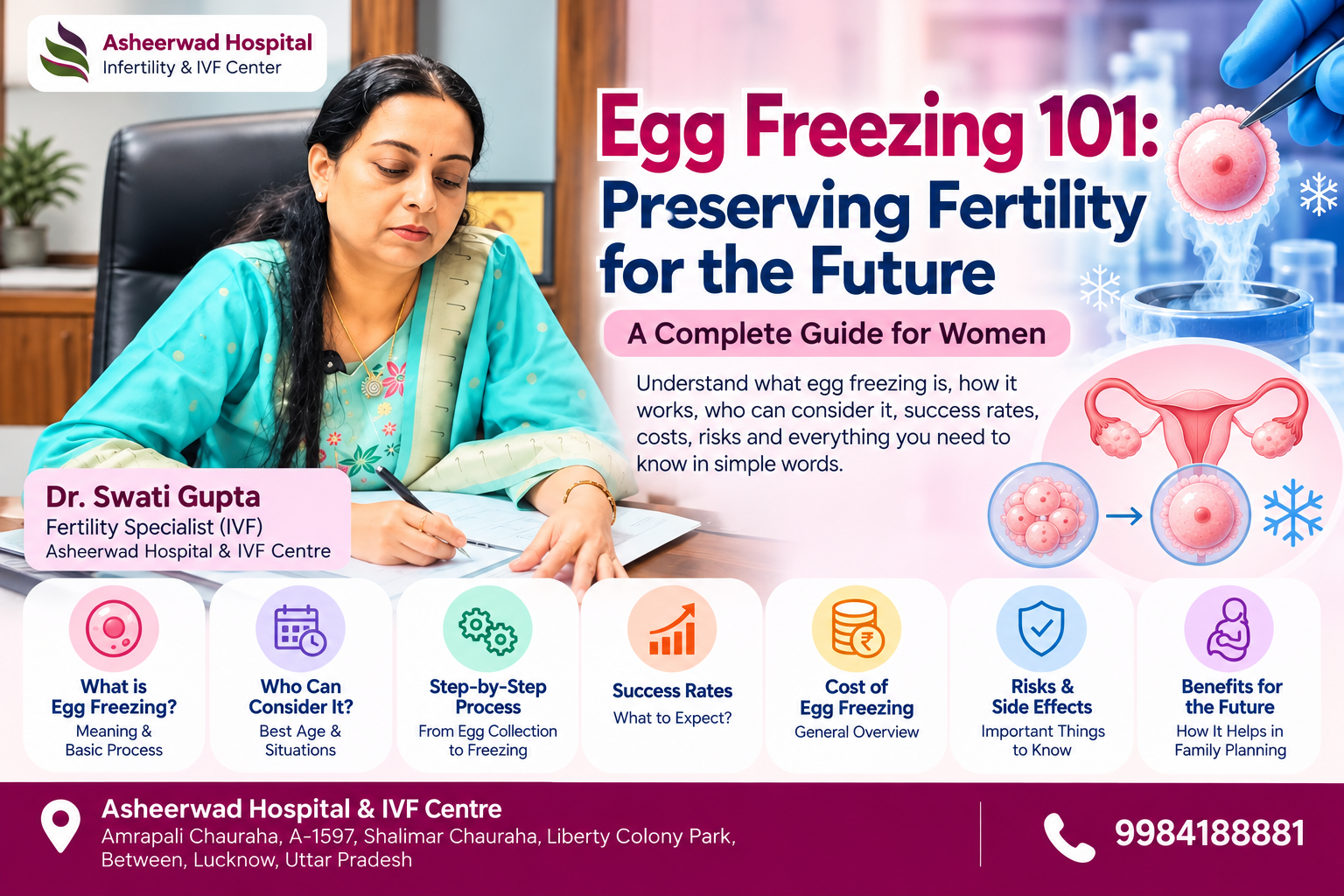
Egg Freezing 101: Preserving Fertility for the Future
Introduction
Fertility does not remain constant throughout a woman’s life. Both the number and quality of eggs generally decline with age, which can make conception more difficult later in life. For women who are not ready to have children now but want to preserve the possibility of having biological children in the future, egg freezing can be an option to discuss with a fertility specialist.
Egg freezing, medically known as oocyte cryopreservation, involves collecting mature eggs from the ovaries and preserving them at very low temperatures for potential future use.
Advances in reproductive medicine have made egg freezing an increasingly recognised fertility-preservation option. However, it is important to understand that egg freezing does not guarantee a future pregnancy. The chances of success depend on several factors, particularly the woman’s age when the eggs are frozen, the number of mature eggs obtained and their quality.
For women researching egg freezing cost in Lucknow, understanding the complete process and associated expenses is an important first step.
What Is Egg Freezing?
Egg freezing is a fertility-preservation technique in which mature eggs are collected from the ovaries and stored for future use.
The process allows a woman to preserve eggs at their current age rather than relying entirely on the quality of eggs available years later.
When the woman decides to attempt pregnancy, the frozen eggs can be thawed. Suitable eggs can then be fertilised with sperm, generally using ICSI (Intracytoplasmic Sperm Injection), to create embryos. An embryo may subsequently be transferred into the uterus.
Egg freezing therefore preserves the eggs, not a guaranteed future pregnancy.
Why Do Women Consider Egg Freezing?
There can be several reasons for considering fertility preservation.
Delaying Parenthood
Some women may wish to postpone pregnancy because of education, career plans, financial circumstances, personal goals or the absence of a suitable partner.
Egg freezing can provide an option to preserve eggs while they are younger.
Medical Reasons
Some medical treatments can affect ovarian function and fertility.
For example, certain cancer treatments may damage the ovaries. Women who are expected to undergo treatments that could affect fertility may discuss fertility preservation with their doctors before treatment begins.
Reduced Ovarian Reserve
Women who are concerned about declining ovarian reserve may discuss fertility preservation with a fertility specialist.
However, ovarian reserve tests cannot predict with certainty whether a woman will become pregnant naturally in the future. A specialist should interpret these tests in the context of age and overall reproductive health.
How Does Egg Freezing Work?
Egg freezing generally involves several stages.
1. Fertility Assessment
The process usually begins with a consultation and fertility assessment.
The doctor may review:
- Age
- Menstrual history
- Previous pregnancies
- Medical history
- Previous ovarian surgery
- Family history
- Fertility goals
Tests such as ultrasound and blood investigations may be recommended to assess ovarian reserve and reproductive health.
2. Ovarian Stimulation
During a normal menstrual cycle, usually one egg becomes mature.
For egg freezing, fertility medicines are used to stimulate the ovaries so that multiple follicles can develop during one treatment cycle.
The woman’s response is monitored using ultrasound and, when necessary, blood tests.
Medication doses may be adjusted depending on the response.
3. Trigger Medication
When the follicles reach an appropriate stage of development, a trigger medicine is administered to help the eggs complete the final stage of maturation.
The timing of the trigger is important because egg retrieval is scheduled according to the expected maturation window.
4. Egg Retrieval
Egg retrieval is performed using a specialised procedure.
A doctor uses ultrasound guidance to access the ovaries and collect the developing eggs from the follicles.
The procedure is generally performed with appropriate pain relief or sedation according to the fertility centre’s protocol.
The collected eggs are then transferred to the embryology laboratory.
5. Egg Assessment and Freezing
The embryology team examines the retrieved eggs and identifies mature eggs suitable for freezing.
Modern egg-freezing programmes commonly use a rapid freezing technique called vitrification.
The eggs are stored in specialised cryogenic conditions for potential future use.
How Are Frozen Eggs Used Later?
When a woman decides to use her frozen eggs, the eggs are carefully thawed.
Not every frozen egg will necessarily survive the thawing process.
Suitable eggs are then fertilised with sperm. ICSI is commonly used because it allows an embryologist to inject a selected sperm directly into the egg.
If fertilisation occurs, the resulting embryos are cultured and evaluated.
An appropriate embryo may then be transferred into the uterus.
Therefore, the journey from frozen egg to pregnancy involves several stages, and success is not guaranteed at every stage.
Does Egg Freezing Guarantee Pregnancy?
No.
This is one of the most important points women should understand before choosing egg freezing.
Freezing eggs preserves an opportunity for future treatment, but it does not guarantee that those eggs will eventually result in a baby.
The outcome can depend on:
- Age when the eggs were frozen
- Number of mature eggs stored
- Egg quality
- Survival after thawing
- Fertilisation
- Embryo development
- Uterine health
- Age and health at the time of embryo transfer
- Sperm quality
The American Society for Reproductive Medicine notes that the age at which eggs are frozen is an important factor in future reproductive outcomes.
Why Age Matters in Egg Freezing
Egg quantity and quality generally decline with increasing age.
This is one reason why the age at which eggs are frozen is important.
Younger eggs generally have a lower risk of chromosomal abnormalities than eggs from older reproductive age groups.
However, there is no single age that is perfect for every woman.
The decision should be based on individual reproductive goals, ovarian reserve, medical history and personal circumstances.
A fertility specialist can explain the potential benefits and limitations for a particular patient.
How Many Eggs Should Be Frozen?
There is no universal number of eggs that guarantees a future baby.
The number of eggs that can be retrieved depends on ovarian reserve, age and response to stimulation.
A fertility specialist can estimate how many eggs may be obtained during a cycle, but the actual number may be higher or lower.
Some women may undergo more than one stimulation and retrieval cycle if medically appropriate.
The decision should be personalised rather than based on a fixed number.
Egg Freezing for Cancer Patients
Fertility preservation can be especially important when a woman is diagnosed with cancer and may need chemotherapy, radiotherapy or certain surgeries.
Some cancer treatments can affect ovarian function.
When time and medical circumstances permit, egg freezing may be discussed before treatment begins.
Fertility preservation should be coordinated between the treating oncologist and fertility specialist so that cancer treatment is not unnecessarily delayed.
Egg Freezing Cost in Lucknow
One of the most common questions is: How much does egg freezing cost in Lucknow?
There is no single fixed cost because expenses can vary between fertility centres and according to the patient’s treatment requirements.
The overall cost may include:
- Initial consultation
- Fertility investigations
- Ultrasound monitoring
- Ovarian stimulation medicines
- Egg retrieval procedure
- Embryology laboratory charges
- Egg vitrification
- Initial cryopreservation
- Annual storage charges
- Future thawing and fertilisation
- ICSI, if required
- Embryo transfer when pregnancy is attempted
Therefore, women comparing egg freezing cost in Lucknow should ask fertility centres for a detailed cost estimate rather than comparing only the advertised package price.
Is Egg Freezing Safe?
Egg freezing is an established fertility-preservation technique, but it involves medical procedures and medications.
Ovarian stimulation can cause side effects such as abdominal discomfort, bloating and mood changes. In some cases, excessive ovarian response can lead to ovarian hyperstimulation syndrome.
Egg retrieval is also a medical procedure with potential risks such as bleeding, infection or injury, although serious complications are uncommon.
A fertility specialist should explain the individual benefits and risks before treatment.
What Should You Ask a Fertility Specialist?
Before deciding on egg freezing, women can ask:
- Is egg freezing suitable for me?
- What is my ovarian reserve?
- How many eggs might I expect to retrieve?
- How does my age affect the expected outcome?
- How many cycles might be recommended?
- What medicines will I need?
- What are the risks of ovarian stimulation?
- How long will the eggs be stored?
- What are the annual storage charges?
- What will future thawing and fertilisation cost?
- Will ICSI be required later?
- What are the realistic chances of achieving a pregnancy?
Having clear answers can help women make an informed decision.
Choosing an Egg Freezing Centre in Lucknow
Women looking for egg freezing services in Lucknow should consider several factors.
Fertility Specialist
Check the qualifications and experience of the fertility specialist.
Embryology Laboratory
Egg freezing depends heavily on laboratory procedures, so appropriate embryology facilities are important.
Cryopreservation Technology
Ask which egg-freezing technology is used and how frozen eggs are stored.
Transparent Pricing
Request a complete estimate covering treatment, medicines, laboratory charges and storage.
Future Treatment Planning
Ask how the centre manages thawing, fertilisation, embryo culture and embryo transfer when the frozen eggs are eventually used.
Counselling
Fertility preservation involves medical, emotional and financial considerations. Proper counselling can help women understand the process.
Conclusion
Egg freezing, or oocyte cryopreservation, is a fertility-preservation option that allows women to preserve mature eggs for possible future use.
It can be considered by women who want to postpone pregnancy, women facing certain medical treatments that may affect fertility, and others who wish to discuss fertility preservation based on their individual circumstances.
The age at which eggs are frozen is an important factor because egg quality generally changes with age. However, egg freezing does not guarantee a future pregnancy.
The process involves fertility assessment, ovarian stimulation, monitoring, egg retrieval, laboratory assessment and cryopreservation. When the eggs are eventually used, they are thawed and generally fertilised through ICSI before embryo development and possible embryo transfer.
For women searching for egg freezing cost in Lucknow, it is important to consider the complete treatment pathway rather than only the initial freezing cost. Medicines, investigations, retrieval, laboratory charges, storage and future use of the eggs can all contribute to the total expense.
A consultation with a qualified fertility specialist can help determine whether egg freezing is appropriate and what treatment plan may be suitable for an individual’s reproductive goals.
Frequently Asked Questions
What is egg freezing?
Egg freezing is a fertility-preservation procedure in which mature eggs are collected from the ovaries and frozen for potential future use.
Does egg freezing guarantee a baby in the future?
No. Egg freezing preserves an opportunity for future treatment but does not guarantee fertilisation, embryo development, pregnancy or live birth.
At what age should a woman freeze her eggs?
There is no single ideal age for everyone. Younger age is generally associated with better egg quality, but the decision should be based on individual circumstances and discussed with a fertility specialist.
How long can frozen eggs be stored?
Eggs can be stored for extended periods under appropriate cryogenic conditions. The applicable storage period and regulations should be confirmed with the fertility centre.
Is egg freezing painful?
Ovarian stimulation involves injections and may cause discomfort or bloating. Egg retrieval is performed using appropriate pain management or sedation according to the clinical protocol.
How much does egg freezing cost in Lucknow?
Costs vary depending on the fertility centre, medicines, laboratory procedures, number of cycles and storage duration. A complete cost estimate should be obtained from the chosen centre.
Can frozen eggs be used for IVF later?
Yes. Frozen eggs can potentially be thawed, fertilised and developed into embryos for possible transfer into the uterus.
Is ICSI used with frozen eggs?
ICSI is commonly used when frozen eggs are thawed for fertilisation, although the exact treatment plan should be determined by the fertility team.
Hospital Details
Asheervad Hospital & IVF Centre
Address: Amrapali Chauraha, A-1597, Shalimar Chauraha, Liberty Colony Park, Between, Indira Nagar, Lucknow – 226016
Phone: 080044 3394
Consultant: Dr. Swati Gupta – Consultant Obstetrician, Gynecologist & Infertility Specialist
Medical Disclaimer: This article is for general educational purposes only and does not constitute medical advice, diagnosis or treatment. Egg freezing and fertility treatment decisions should be made after consultation with a qualified fertility specialist. Costs, facilities, treatment protocols and availability may change, so patients should confirm current details directly with the fertility centre.