

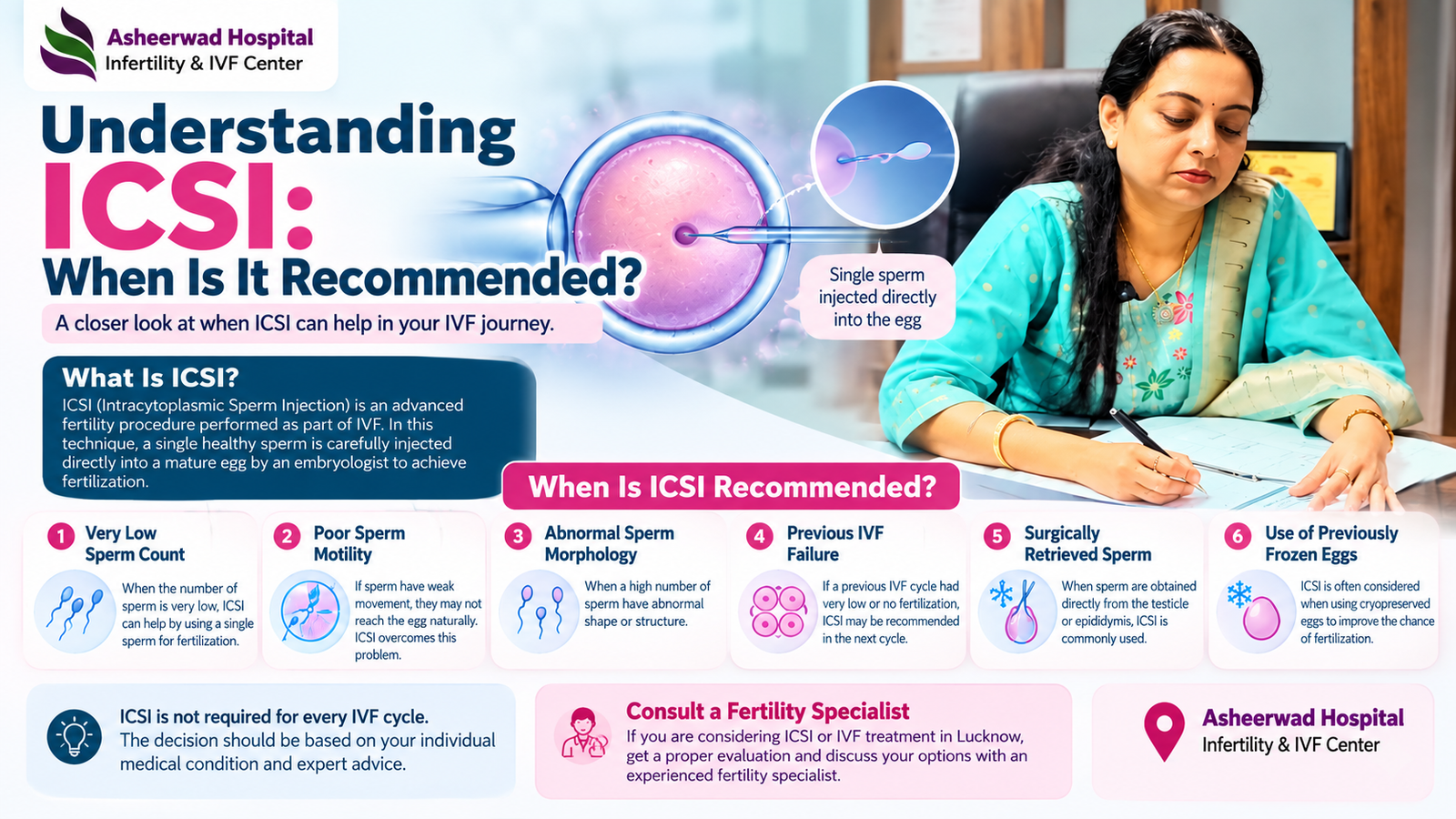
Understanding ICSI: When Is It Recommended?
Introduction
Infertility can affect both men and women, and assisted reproductive technologies have provided several treatment options for couples who are having difficulty conceiving. One such advanced fertility treatment is Intracytoplasmic Sperm Injection (ICSI).
ICSI is a specialised laboratory technique used as part of an IVF treatment cycle. Instead of allowing sperm and egg to fertilise together in a laboratory dish, an embryologist injects a single sperm directly into a mature egg to assist fertilisation.
ICSI can be particularly useful when there is a significant male-factor infertility issue or when conventional IVF has previously resulted in poor or failed fertilisation. However, it is not automatically required for every IVF patient.
The decision to use ICSI should be based on the couple’s fertility evaluation, previous treatment history, sperm and egg factors, and the recommendations of the fertility specialist.
What Is ICSI?
ICSI stands for Intracytoplasmic Sperm Injection.
It is a laboratory procedure performed during IVF treatment.
In conventional IVF, thousands of sperm are placed around an egg in a laboratory dish and one sperm normally fertilises the egg on its own.
With ICSI, an embryologist selects an individual sperm and carefully injects it directly into the egg using specialised laboratory equipment.
The basic process is:
- Eggs are collected following ovarian stimulation.
- The eggs are examined in the embryology laboratory.
- A suitable sperm is selected.
- A single sperm is injected directly into a mature egg.
- The fertilised egg is monitored for embryo development.
- Suitable embryos may subsequently be transferred to the uterus or cryopreserved, depending on the treatment plan.
ICSI therefore focuses specifically on assisting the fertilisation stage of IVF.
Why Is ICSI Used?
The primary reason for using ICSI is to overcome problems that may make fertilisation difficult.
According to the American Society for Reproductive Medicine (ASRM), ICSI was developed primarily to improve fertilisation in couples undergoing IVF when there is male-factor infertility. It can also be useful when a previous IVF cycle resulted in low or absent fertilisation despite no obvious sperm abnormality.
The important point is that ICSI is mainly a fertilisation technique. It does not automatically improve every stage of fertility treatment.
For example, ICSI cannot correct problems involving embryo development, implantation or other causes of infertility.
When Is ICSI Recommended?
1. Severe Male-Factor Infertility
One of the most established reasons for using ICSI is significant male-factor infertility.
Male infertility can involve problems such as:
- Very low sperm concentration
- Poor sperm motility
- Abnormal sperm morphology
- Difficulty obtaining sperm
- Certain sperm-production problems
- Certain sperm-transport problems
When there are very few sperm available or the sperm have difficulty fertilising an egg naturally in the laboratory, ICSI may provide a way to directly introduce a selected sperm into the egg.
The exact treatment depends on the results of the male fertility evaluation.
2. Previous IVF Cycle With Failed Fertilisation
Another important indication is a previous IVF cycle in which fertilisation was very low or completely failed following conventional insemination.
In such cases, the fertility team may consider ICSI during a subsequent cycle.
Current ASRM guidance states that ICSI can increase fertilisation rates when unexpectedly low or failed fertilisation has previously occurred with conventional insemination.
This does not mean that ICSI guarantees pregnancy. Its primary purpose in this situation is to improve the likelihood that mature eggs will become fertilised.
3. Very Low Number of Sperm
When only a small number of sperm are available, conventional IVF may not be the most suitable fertilisation approach.
ICSI requires only one sperm for each mature egg being injected.
This can be particularly relevant in cases of severe sperm-count abnormalities.
However, the fertility specialist and embryology team must assess the available sperm and determine the most appropriate fertilisation method.
4. Poor Sperm Motility
Sperm motility refers to the ability of sperm to move effectively.
If sperm movement is significantly impaired, reaching and penetrating an egg during conventional IVF may be difficult.
ICSI can bypass some of these challenges because the embryologist directly introduces a selected sperm into the egg.
The underlying cause of poor sperm motility should still be investigated because ICSI addresses fertilisation rather than necessarily treating the underlying male infertility.
5. Abnormal Sperm Morphology
Sperm morphology refers to the shape and structure of sperm.
A high proportion of abnormally shaped sperm may sometimes be associated with reduced fertilisation potential.
Depending on the overall semen analysis and clinical circumstances, ICSI may be considered.
Importantly, fertility decisions are generally not made using morphology alone. Sperm concentration, motility, previous fertility history and other clinical factors may also be considered.
6. Surgically Retrieved Sperm
Some men may have no sperm present in the ejaculate but may still have sperm that can be retrieved directly from the reproductive tract or testicular tissue.
Procedures such as surgical sperm retrieval may be considered in selected cases.
If viable sperm are obtained, ICSI is commonly used because the number of available sperm may be very limited.
The specific retrieval technique depends on the underlying cause of infertility.
7. Previously Cryopreserved Eggs
ICSI is also commonly used when previously frozen eggs are being fertilised.
Egg freezing involves preserving mature eggs for possible future use.
According to current ASRM guidance, ICSI is the established method commonly used to fertilise cryopreserved oocytes, although treatment decisions still depend on the individual circumstances.
Is ICSI Required for Every IVF Patient?
No.
This is an important point for patients considering IVF.
ICSI is sometimes used routinely by fertility clinics, but current evidence does not support automatically using ICSI for every IVF cycle when there is no male-factor infertility or previous fertilisation failure.
The 2026 ASRM committee opinion concludes that routine ICSI for patients without male-factor infertility is not recommended and does not improve live-birth outcomes in several non-male-factor situations.
Therefore, patients should ask their fertility specialist why ICSI is being recommended in their specific case.
ICSI vs Conventional IVF
The major difference is how fertilisation occurs.
| Conventional IVF | ICSI |
|---|---|
| Sperm are placed around the egg | One sperm is injected directly into the egg |
| Fertilisation occurs without direct sperm injection | Embryologist assists fertilisation |
| Often suitable when sperm parameters are adequate | Particularly useful in selected male-factor cases |
| No individual sperm injection | Requires specialised micromanipulation |
| May be appropriate for many standard IVF cases | Usually selected based on clinical circumstances |
Both procedures are part of IVF treatment and ultimately aim to produce embryos that can potentially lead to pregnancy.
Does ICSI Guarantee Pregnancy?
No.
ICSI is designed to assist fertilisation; it does not guarantee pregnancy or a live birth.
Pregnancy outcomes can depend on many factors, including:
- Age of the woman
- Egg quality
- Sperm quality
- Embryo quality
- Uterine health
- Underlying infertility diagnosis
- Number of embryos available
- Genetic characteristics of embryos
- Overall reproductive health
Even when an egg is successfully fertilised through ICSI, the resulting embryo still needs to develop appropriately and successfully implant in the uterus.
ICSI and Embryo Development
After fertilisation, the embryo is monitored in the laboratory.
The embryo may develop through several stages before a transfer is considered.
The fertility team evaluates embryo development and determines the appropriate treatment plan.
ICSI itself does not guarantee that every injected egg will fertilise or that every fertilised egg will develop into a transferable embryo.
This is why patients should understand that ICSI addresses one specific part of the IVF process.
What Happens Before ICSI?
Before an ICSI cycle, both partners usually undergo fertility evaluation.
For the female partner, assessment may involve:
- Medical and reproductive history
- Hormonal evaluation when indicated
- Ovarian reserve assessment
- Ultrasound
- Uterine assessment when required
For the male partner, evaluation may include:
- Semen analysis
- Medical history
- Physical examination when appropriate
- Hormonal testing in selected cases
- Additional male fertility investigations when indicated
The exact tests vary according to the couple’s medical history.
What Happens on the Day of Egg Retrieval?
During an IVF cycle, ovarian stimulation is used to encourage the development of multiple follicles.
When the follicles are ready, eggs are collected through an egg-retrieval procedure.
The embryology laboratory then identifies mature eggs suitable for fertilisation.
If ICSI has been selected, an embryologist prepares the sperm and performs the injection procedure using specialised equipment.
The eggs are subsequently monitored for signs of fertilisation.
Are There Risks Associated With ICSI?
ICSI is a specialised laboratory procedure, and no medical treatment is completely risk-free.
Potential considerations include:
- Not every injected egg will fertilise.
- Not every fertilised egg will develop into a viable embryo.
- The procedure adds laboratory complexity and cost.
- Some evidence suggests a small increase in certain risks in children conceived using ICSI, although separating the effects of ICSI from the underlying infertility can be difficult.
The 2026 ASRM guidance notes an association between ICSI and a small increased risk of birth defects, while also noting uncertainty about how much of this association is attributable specifically to ICSI versus other factors.
Patients should discuss individual risks with their fertility specialist.
How Much Does ICSI Cost?
The cost of ICSI varies considerably depending on the fertility centre, city, treatment plan, medications, laboratory services and whether additional procedures are required.
ICSI generally involves an additional laboratory procedure compared with conventional IVF.
Patients should ask the fertility centre for a complete treatment estimate covering:
- Consultation
- Fertility investigations
- Medicines
- Egg retrieval
- IVF/ICSI laboratory charges
- Embryo culture
- Embryo transfer
- Cryopreservation
- Frozen embryo transfer, if required
A clear estimate can help couples plan financially.
Is ICSI Available in Lucknow?
ICSI is an assisted reproductive technology offered by fertility and IVF centres in many major Indian cities, including Lucknow.
Couples searching for ICSI treatment in Lucknow should compare fertility centres based on factors such as:
- Qualification and experience of fertility specialists
- Embryology laboratory facilities
- Male infertility services
- Availability of sperm-retrieval procedures
- Embryo culture facilities
- Transparency of treatment costs
- Follow-up care
- Counselling and patient support
Patients should choose a centre based on their individual medical requirements rather than relying only on advertised success rates.
Questions to Ask Your Fertility Specialist
Before deciding on ICSI, couples can ask:
- Why is ICSI recommended in our case?
- Is there evidence of male-factor infertility?
- Would conventional IVF also be appropriate?
- Have we had fertilisation failure in a previous IVF cycle?
- What are the expected benefits of ICSI for us?
- What additional cost will ICSI involve?
- How many eggs are expected to be suitable for injection?
- What happens if fertilisation does not occur?
- What are the possible risks?
- What other fertility treatment options are available?
These questions can help couples understand the reasoning behind the treatment recommendation.
Conclusion
Intracytoplasmic Sperm Injection (ICSI) is an important laboratory technique used during IVF to assist fertilisation by injecting a single sperm directly into a mature egg.
It is particularly established for cases involving male-factor infertility, including significantly abnormal sperm parameters, and may also be considered when a previous conventional IVF cycle resulted in unexpectedly low or failed fertilisation. It is also commonly used for fertilisation of cryopreserved eggs.
However, ICSI is not automatically necessary for every IVF patient. Current evidence does not support routine ICSI for people without male-factor infertility or a history of fertilisation failure.
The most appropriate fertilisation method should therefore be decided after evaluating both partners, understanding the cause of infertility and considering previous treatment outcomes.
For couples considering ICSI treatment in Lucknow, a consultation with a qualified fertility specialist can help determine whether ICSI, conventional IVF or another fertility treatment is appropriate for their situation.
Frequently Asked Questions
What does ICSI stand for?
ICSI stands for Intracytoplasmic Sperm Injection.
Is ICSI the same as IVF?
No. ICSI is a fertilisation technique that can be performed as part of an IVF cycle.
When is ICSI usually recommended?
It is particularly used for male-factor infertility and previous poor or failed fertilisation with conventional IVF.
Is ICSI required for every IVF cycle?
No. Routine ICSI is not recommended for all IVF patients without an appropriate indication.
Can ICSI help with very low sperm count?
It may be useful in selected cases of severe male-factor infertility because a single suitable sperm can be injected directly into a mature egg.
Does ICSI guarantee pregnancy?
No. ICSI assists fertilisation but does not guarantee embryo development, implantation, pregnancy or live birth.
Can ICSI be used with frozen eggs?
Yes. ICSI is commonly used to fertilise cryopreserved mature eggs.
Is ICSI more expensive than conventional IVF?
Usually, ICSI involves an additional laboratory procedure and may therefore add to the overall IVF cost.
Medical Disclaimer: This article is intended for general educational purposes only and should not be considered a diagnosis or personalised medical advice. Fertility treatment decisions, including whether ICSI is appropriate, should be made with a qualified fertility specialist after evaluation of both partners.